Profit over the distance comes not from guessing where the price will go, but from repeating the same vetted actions by the rules. These rules are the trading system: when to enter, when to exit, how much to risk. Around it lives a trading plan with personal discipline, a backtest checks it on history, and the honest mirror of your whole trading is the journal.
Trading is at heart a fairly monotonous craft, not a game of chance, and it rests on four things: system, plan, check and journal. Most beginners trade on a hunch and naturally lose the account, because the market by default takes money through costs. I've traded for years and long ago understood the main thing: almost no one fails a system at the building stage, they fail it at the adherence stage, when after a loss they want to win it back and all the pretty rules fly into the bin.
In this article we'll cover:
- a trading system is clear rules of entry, exit and risk, not a set of hunches;
- the plan is the personal rules around the system, and the journal is the honest mirror of your trading;
- a backtest checks the edge on history, but it easily fools you by fitting to the past;
- a working but followed system always beats a perfect but abandoned one.
Let's start with what a trading system even is and why without it the account is doomed.

What a trading system is and why you need one
A trading system is a set of preset rules that determine under what conditions to open and close a trade and how much to risk in doing so. Its task sounds almost mathematical: to pull your average result over the long distance into the green.
The reason is simple. The market initially leaves you at a small minus because of costs, and the system's job is to tip that probability onto your side. Until the average result over a long stretch comes out positive, any strategy that looks pretty will in the end drift to zero. Its second gift is order instead of fuss: when the scenario is written out before the trade, in the moment you don't trade on your nerves and don't try to out-argue the market. The hardest thing of all is not to invent the rules but to grind through the same fine-tuned actions over and over, without breaking into improvisation. How exactly a practising trader's system is built I show in the course section on the trading system.
It is worth separating two kinds of system at once so as not to confuse them. A mechanical system is a set of unambiguous rules you could hand to a robot: if these conditions are met, open, exit there. A discretionary system also rests on rules, but the final decision is made by a human reading the context by eye. Mine is the second kind: I have hard frames for risk and setup, but I confirm the entry by reading volume and the market phase, not by a formula firing. This must not be confused with trading on a hunch: discretion without rules is a casino, while a system without discretion often breaks where the market changes character. I hold to the frames but keep the right not to enter when the volume picture does not add up, and it is exactly this pairing of rules and common sense, not blind automation, that works for me over the distance.
In short: A system is rules of entry, exit and risk written out in advance; its meaning is purely arithmetic, to bring the average result over the distance into the green where costs initially drag the account into the red.
What a trading system is made of: entry, exit and risk
Any working system is assembled from three mandatory parts. The first is the entry condition, your signal. For me a trade appears when several parameters converge: price at a significant level, confirmation by volume and the footprint of large capital. Approaches to the signal differ, many build it on the logic of Smart Money and volume analysis, but the essence is one: the entry must have a clear and repeatable condition, not a feeling.
The second block is the exit rules: where you take profit and where you agree that you were wrong. Both the trade's target and the indispensable stop live in it. The third, weightiest block is risk management, that is, what part of the account you're willing to give to one position. It's precisely this that determines whether you survive the inevitable string of losses or not, and there's more on it in the piece on money management. All of this I bring down into a simple set of rules and don't deviate from it, because a system works exactly as far as you follow it. My approach to signals on a live chart I break down in the video: a trading strategy for beginners.
In short: The three bricks of a system are the entry signal, the exit with target and stop, and risk management; and it's exactly the share of the account in a trade that determines whether you'll withstand the inevitable run of losses.
The trading plan: how it differs from the system
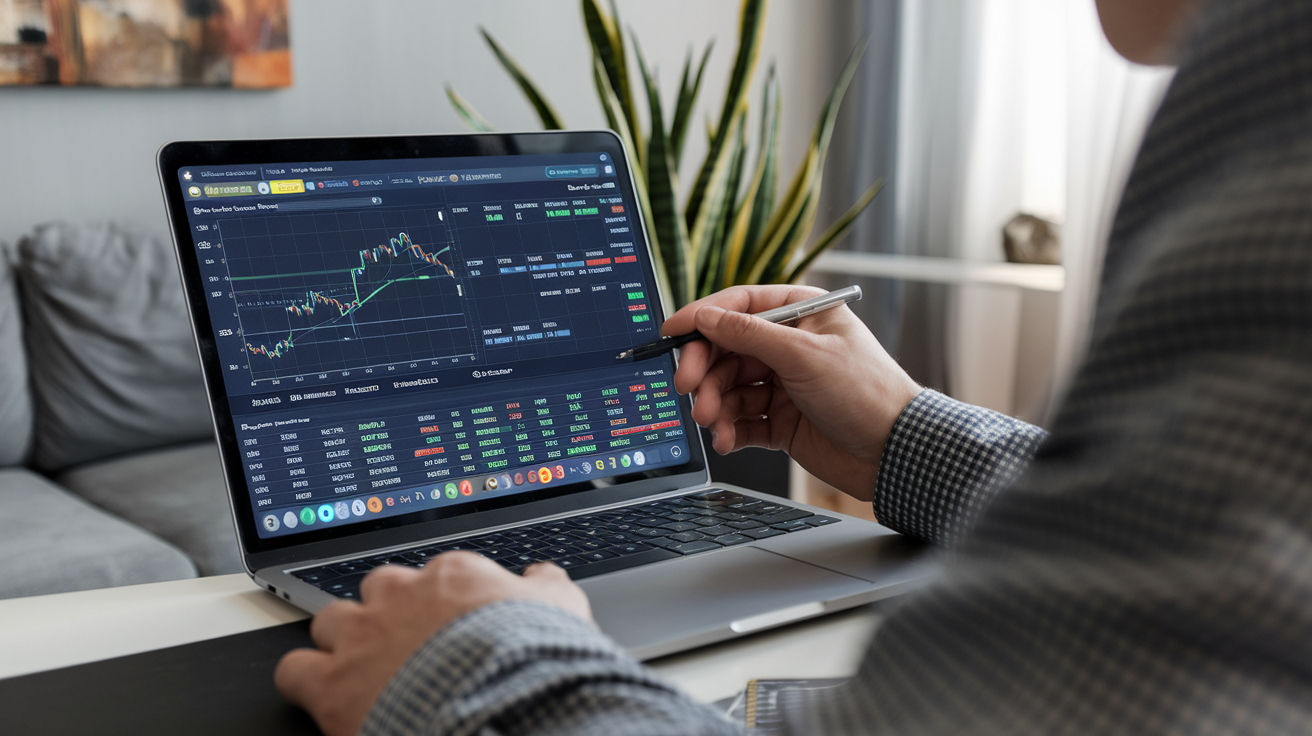
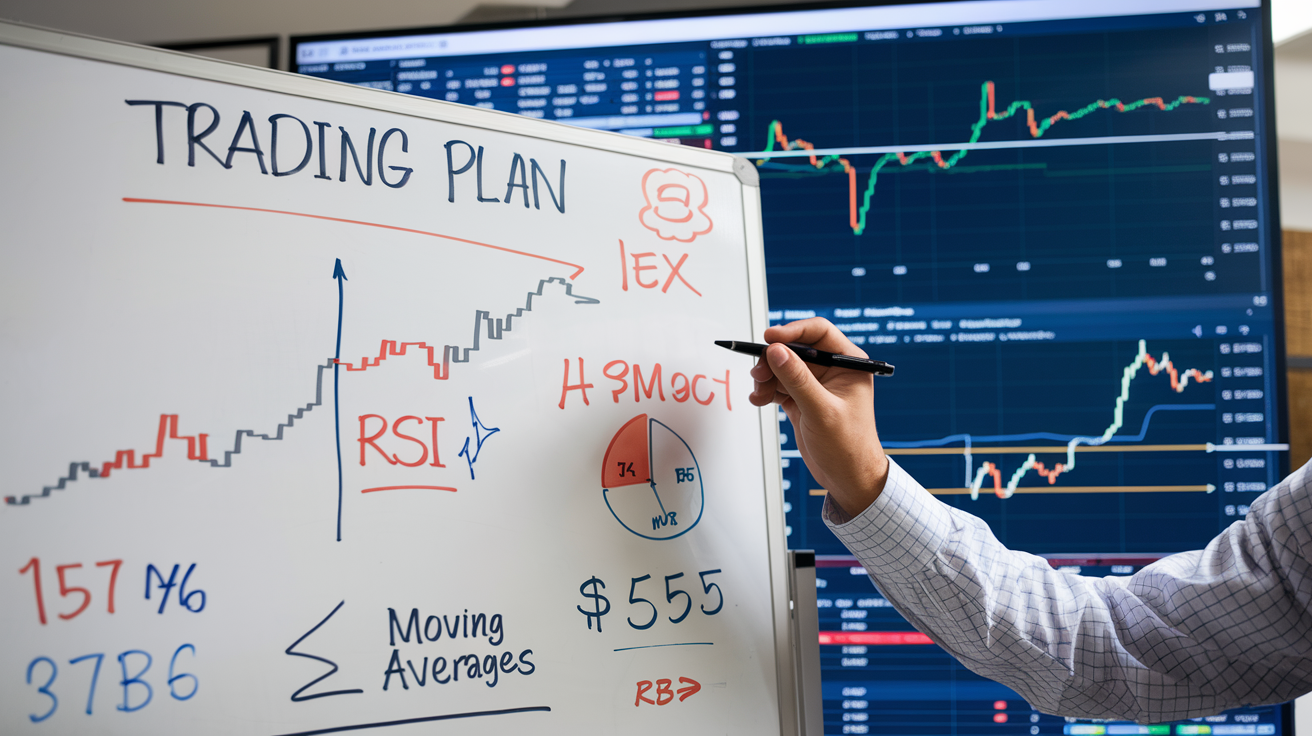
A trading plan is a written set of rules by which you trade: which instruments, in what conditions, where the entry, where the stop, where the target and what risk. It's not worth confusing it with the system: the system is the method and the entry signal itself, while the plan is your personal rules around it, that is risk, discipline and the decision of what you trade and what you skip.
Why it's needed at all. Without clear rules of entry and exit a trader's average result is negative by default: they enter on emotion, hold a loss in hope and cut profit too early. A rule written in advance removes exactly this, because in the moment of the trade there's no longer any thinking to do, and emotions stop running the account. A good plan is short and concrete, and I keep just a few points in it: what I trade and in what conditions I enter, my signal, where the stop and where the target with a set ratio, what risk per trade as a small share of the account, the rules for carrying a position such as moving the stop to breakeven, and personal stop-signals for when trading is off, for example after a string of losses or on strong emotions. And here the main difficulty is buried: writing a plan is half the job, following it when the market presses is much harder. So I keep my plan as short as possible: the fewer the points, the higher the chance of actually following it. Rules that spin in your head but are written down nowhere are not yet a plan.
In short: The system is the method and the signal, the plan is the personal rules around it: instruments, stop, target, risk as a small share and stop-signals for yourself; the shorter the plan, the higher the chance of following it.
Backtesting: how to test a strategy on history without fooling yourself
A backtest is a check of a trading strategy on the market's historical data, to assess whether it had profit in the past and how stably it worked. Roughly speaking, you run your rules over history that has already happened and see whether the system had a profit.
It's needed for one thing: to understand whether the strategy has an edge before carrying it to a real account. If the entry and exit rules gave a steady plus on a large stretch of history, it makes sense to look more seriously; if they steadily lost, better to find that out on the past for free than to pay for the lesson with live money. There are two ways. A manual backtest is when you scroll the chart back and check the strategy trade by trade, marking the entry, the stop and the exit; it's slow, but you see with your own eyes how the system behaves in different conditions and immediately notice where it breaks. An automatic one is running the rules on a platform that counts the result over the whole history in seconds; it's fast, but the easier it is to turn the parameters, the stronger the temptation to draw a pretty curve. For a beginner I advise starting with the manual one: it's more honest and teaches you to understand the market rather than tweak the numbers.
The main trap, though, is overoptimization, also known as fitting to history. When the parameters are turned up to a perfect curve on past data, the system doesn't find an edge but simply describes what has already happened, and on new data it falls apart, since the market doesn't repeat history literally. The defence is simple and more reliable than any pretty curve: split the history into two parts, build and tune the strategy on one, and check the result on the second, untouched part. A plus on the part you didn't touch too is a serious sign; a plus only where you turned the parameters is the classic fit. And remember commissions and slippage: without them the paper profit easily turns into a loss on a real account.
In short: A backtest runs the rules over history to see the edge before real money; start with the manual one, split the data into a tuning part and an untouched part, and if there's a plus only where you turned the parameters, that's a fit.
Forward testing: a hundred trades on demo before going live
A backtest is only the first filter, not a verdict, and you can't launch the system on real money straight away. One trade or ten prove nothing, it could be plain luck or bad luck. The real edge shows up only over the distance, so after history comes the forward test: running the rules over new data the system hasn't yet seen, about a hundred trades and better first on a demo account. There you can no longer fit the strategy after the fact, and it's an honest check with costs taken into account.
On such a sample three things interest me. The first is the total result: did the system come out positive after all commissions. The second is the evenness: isn't the whole plus held up by one stray large trade. The third is how steadily I held to the rules under pressure, without breaking them. Only after passing this filter does the system go to a small live account. And it's not a stone slab: from the results of a hundred trades its weak spots become visible, which you carefully correct rather than tear it all down after yet another minus. And here's my contrarian conclusion: the best system is the one that's simpler than the rest but still gives an edge. How many times I've watched people shuffle systems for years in search of the ideal, when the snag wasn't in the rules but in the fact that they were abandoned at the market's very first push. Every extra condition and filter makes following harder, which is why a modest system you stick to always outdoes a flawless one dropped halfway. An intricate one flatters the ego, a simple one brings the money.
In short: After the backtest run a forward test on new data, about a hundred trades and better on demo, looking at the total, the evenness and your adherence to the rules; a simple followed system beats a complex abandoned one.
The trader's journal: what to record and how to find your mistakes
A trader's journal is a structured record of all the trades made, with the reasons for entry and exit, the result and the emotional state, which helps to find and fix recurring mistakes. In essence it's a trading log that won't let you deceive yourself.
It's needed for a simple reason: a trader's memory is unreliable. Without records the brain slips you a convenient picture, the lucky trades are remembered vividly, the failed ones quietly forgotten or written off to chance. A person is sure they trade decently, while the account says the opposite. Records bring honesty back, since dry figures, unlike memory, don't embellish. It's worth recording more than just profit and loss: the instrument, the date, the direction, the entry and exit points, the stop size and the result, and above all two things besides the figures. The first is the reason for entry, that is which signal of your system fired, whether you're trading by the rules or by mood. The second is your emotional state: were you calm, did you enter on a thrill or were you winning back after a loss. It's precisely emotions that most often stand behind the failed trades. The format is any, be it a table, notes or screenshots with marks right on the chart, as long as you keep it honestly and without gaps.
The main benefit reveals itself not in the moment but over the distance, when at least a few dozen trades have accumulated. Then patterns surface in the records: for example, it becomes visible that most of the losses fall on trades after a minus already taken, that is on attempts to win back, on tilt after a loss, on a thrill or a breach of your own stop rule. But keeping a journal isn't enough, you also have to re-read it: once a week look through the records and search for repeats. What turns the journal into a tool of growth is not the record itself but the habit of returning to it and going through it. These recurring mistakes are your personal rakes, and without the journal you simply wouldn't see them, and most of the typical beginners' mistakes surface exactly here, the moment you start recording honestly. What you measure, you can also fix. How to keep such a journal conveniently and what to go through in it I've laid out in the course section on the trader's journal.
In short: The journal is the mirror against the self-deception of memory: record not only the result but the reason for entry and the emotion, and re-read it once a week, since losses come more often from departures from the rules than from the signals themselves.
Frequently asked questions
It's a set of preset rules: when to enter a trade, when to exit and how much to risk. Its job is to make the average result over the distance positive and remove chaotic decisions made on emotion. Without a system, trading turns into a coin toss.
The system is the method and the entry signal itself. The plan is your personal rules around it: what risk per trade, what you trade and what you skip, when it's better not to enter the market at all. The system answers the question of how, the plan answers how exactly you behave.
First a backtest on history, then a forward test. Run the rules over past data, then necessarily over new data the system hasn't seen, on demo or a small real account. A distance of about a hundred trades shows the real edge with costs taken into account.
It's fitting the strategy's parameters to history up to a perfect curve. As a result the strategy describes the past rather than finding a working edge, and on new data it falls apart. The more precisely it sits on history, the worse it usually works afterward.
To see your recurring mistakes from the outside and remove them. Memory is unreliable: the lucky trades are remembered, the failed ones forgotten. The journal removes this self-deception and shows the real statistics, if you record the reason for entry and the emotions, not just the result.
In my experience the simplest of those that give an edge. The more conditions and filters in a system, the harder it is to follow. A working but followed system always beats a perfect one abandoned at the market's first pressure.
About the Author
Author: Igor Arapov — independent researcher in the psychology of investment decisions and behavioral finance, practising trader since 2013, founder of arapov.trade, author of a trading book series (ORCID: 0009-0003-0430-778X).