Most people come to crypto for easy money and lose on the one thing they skipped: understanding the asset itself. Cryptocurrency lives on a blockchain and is not issued by a state, most coins have no intrinsic value, and no single regulator sits over the market, so the risks here run higher than on classic markets. It is worth understanding the nature of the asset before you put your first money on an exchange.
When I started out, forex was on everyone's lips; now crypto is the one in the headlines: who got rich, who lost it all. People read that and come to the market because the entry looks easy and the coins look mysterious. Let me walk it calmly and without the technical thickets: what cryptocurrency actually is, what holds it up, where it is risky, and how to take the first step so you do not drain your account at the very start.
In this article we'll cover:
- cryptocurrency is a digital asset on a blockchain that no state issues or guarantees;
- a blockchain is a distributed ledger kept by all nodes of the network, not by one bank;
- the main differences are the absence of a regulator, high volatility, and a flood of dubious projects;
- the right start is method first, then a demo account, and only then a small real account with a stop.
Start with the simplest question: what kind of asset this even is.
What is cryptocurrency in simple terms
Cryptocurrency is a digital asset issued and stored not by a bank but by a computer network based on a blockchain, one you can exchange directly between participants.
It is easiest to compare with ordinary money. Money has the reputation of a state behind it, one that almost never goes bankrupt, so we trust it. Cryptocurrencies have no such guarantor: the network creates the coins, and you exchange your money for them by trusting the system itself. Most coins have no intrinsic value the way a security does, so their price rests on demand alone. The exception, to my mind, is Bitcoin: its issuance is capped, no more than 21 million coins, which gives it the traits of a scarce asset, close to gold. A little apart stands Ether too, as a platform for applications. Everything else, the thousands of altcoins, is essentially a superstructure over these two ideas, and the vast majority of them have neither a capped issuance nor a real use, so their price is pure demand and nothing more.
In short: Cryptocurrency is a digital asset with no state guarantor, the value of most coins rests on demand alone, and the exception is Bitcoin with its 21 million cap.
Blockchain and decentralization: how it works
At the core of any cryptocurrency sits a blockchain. Put simply, it is a shared notebook of transfer records, a copy of which is held at once by many participants of the network. When a transaction happens, everyone writes it down, so forging or erasing a record after the fact is practically impossible. That is exactly the sense of the word decentralization: there is no single center that controls everything and that you have to take at its word.
The technology itself is strong, and I will not praise it or knock it as an engineer; I look from a trader's seat. What matters for us is this: with no central body, there is no usual protection either. No one will reverse a mistaken transfer, freeze a fraudster on a phone call, or guarantee your money back. Convenience and freedom here come bundled with full responsibility for your own actions, and on this mechanic both the upsides and almost all the risks of crypto are built.
It is worth separating at once the two ways a network reaches agreement and issues coins, because different coins are built on them. Proof of Work, the work proof, is mining: thousands of computers burn electricity solving a seemingly useless puzzle, and whoever solves it first writes the block and takes the reward. Bitcoin is secured this way. Proof of Stake, the stake proof, replaces computation with an account: the right to write a block goes to whoever has frozen their coins in staking, and they risk those coins if they cheat. Ether after its upgrade and most new networks work this way. For a trader this is not abstract: PoW coins are costlier to produce and therefore less often empty shells, while PoS networks are faster and cheaper but lean their security on whoever has locked a large stake.
In short: A blockchain is a shared ledger across many nodes, so a record cannot be forged, but the usual protection is gone too: a mistaken transfer no one will reverse.
Types of cryptocurrency: coins, altcoins and stablecoins
There are thousands of coins, but for practice it helps to sort them into a few groups. Bitcoin stands apart as digital gold with a capped issuance. Ether is already a platform on which applications and other tokens live. Everything else is usually called altcoins, and the quality varies wildly: from large working networks to outright hollow shells. A good example of a tricky altcoin is XRP on the Ripple network: a regulator's lawsuit hung over it for years, and the price was driven by court news, not by the chart. Coins like that I do not guess by hype; I read them like any asset, by levels and volume.
A separate and very practical group is the stablecoin, a cryptocurrency pegged to a stable price, most often to the dollar one to one. For a trader it works in two roles at once: a safe harbor where you park capital between trades without cashing out to a bank, and a trading pair through which you buy and sell the rest of your crypto. But the word stable is misleading here: the peg is held either by live reserves or by an algorithm, and the algorithmic version with no real money under it breaks the easiest. How USDT differs from USDC and where the real risk in stables sits I cover in the piece on stablecoins and Tether.
There is a nuance with altcoins worth accepting upfront: almost every one of them follows Bitcoin, only amplified. Bitcoin twitches a percent, the average alt twitches harder, and a small illiquid one shoots several times as far, and it works both ways. On top of that come two more pits. Thin liquidity: a small coin's book holds little money, so one large order moves the price in a jolt, and on the way out you catch slippage. And the quiet death of a project: the team drops development, the coin gets delisted, the chart drifts into a flat line near zero. I have seen dozens of coins that promised to become the next Ether and ended in delisting, so I treat alts coldly: I take a couple of large, clear assets such as the Solana network, watch their link to Bitcoin and do not fall in love with a project.
In short: Bitcoin is digital gold, Ether a platform, the rest altcoins of varying quality; alts follow Bitcoin amplified, and their main risks are thin liquidity, jolting volatility and the chance of delisting. A stablecoin holds its rate to the dollar and serves as a safe harbor and a trading pair, but an algorithmic peg with no reserves is unreliable.
How crypto differs from traditional finance: the key risks
The first difference is the absence of a single regulator. Supervisory bodies stand over the stock market, while crypto largely lives on its own. For me that was a reason to trade regulated futures first of all, and that is my personal stance. The second difference is volatility: a young market with a small capitalization swings far harder than currencies or stocks. The ease of entry is deceptive on top of that: you can open an account and buy a coin in ten minutes, and that breeds an illusion of simplicity.
A separate risk is the projects themselves. A sea of dubious coins and meme coins get pumped to sell to beginners at the top, after which they often vanish from the exchanges.
So I keep the base rule simple: focus on large, clear assets, a mandatory accounting for typical beginner mistakes, and entry only with money you can afford to lose. And here is what I figured out over the years: what hurts a beginner in crypto is not a gap in blockchain knowledge but the absence of a cold attitude to money. People mistake the digital wrapper for magic, as if a new technology makes earning easier, but it does not; the market obeys the same supply and demand as any other. In essence the basics of crypto are ninety percent about risk, not technology. I cover the topic in more detail in the video on cryptocurrency for beginners.
In short: The main difference of crypto is the absence of a regulator and high volatility, and the basics themselves are ninety percent about risk, not technology.
How to start trading crypto: choosing an exchange and wallet
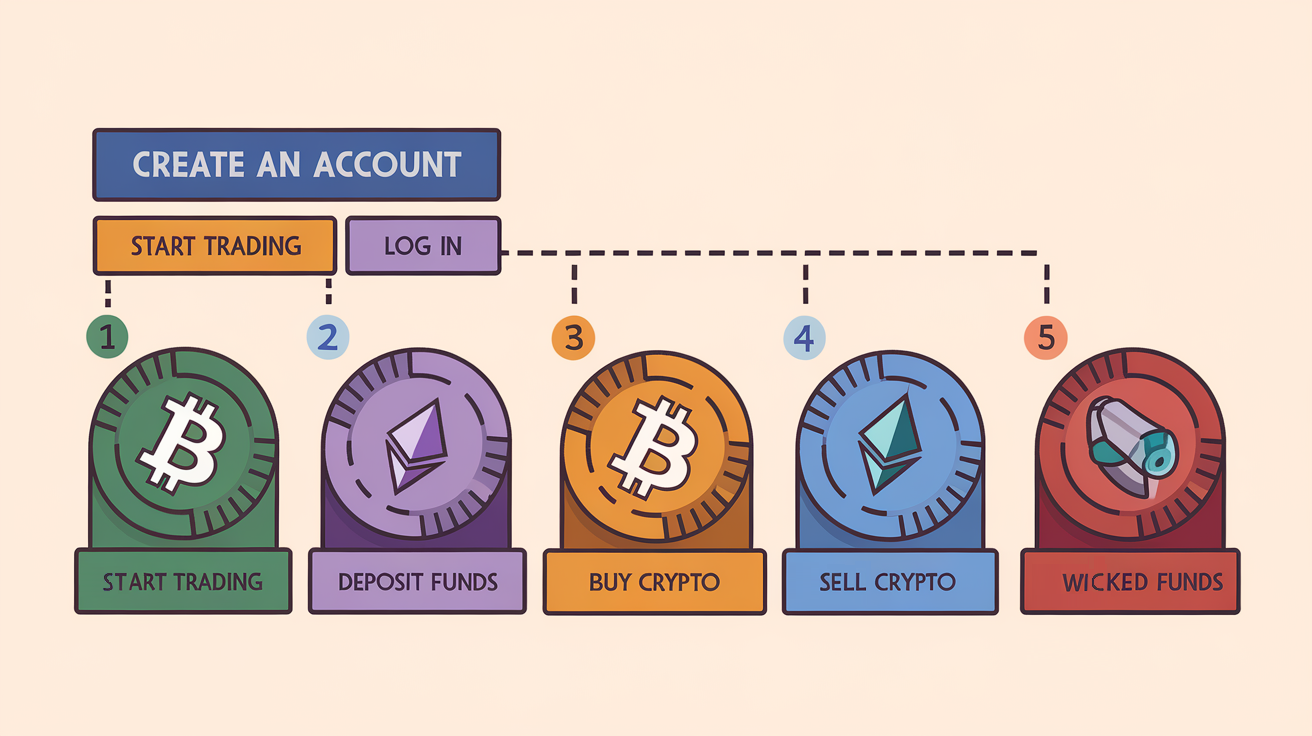
A crypto exchange is a venue where cryptocurrencies are bought and sold. The path begins exactly with choosing such a venue, and here is my main advice: look first of all at reliability, not at ads and bonuses.
Here is what I pay attention to. Regulation and reputation: how long the exchange has been around, whether it holds a license, whether there were scandals over withdrawals. Liquidity, so you can get in and out easily. And fees, which quietly eat into the result. A separate matter is storage: keeping all your assets on the exchange is risky, since it can be hacked, so large amounts are moved to a separate wallet. Then comes registration and verification. Serious exchanges ask you to confirm your identity, which is called KYC, and there is no need to be scared: the presence of verification is more a sign that the venue plays by the rules.
In short: Choose an exchange by reliability, regulation, liquidity, and fees, not by bonuses, and keep large amounts not on the exchange but in a separate wallet.
How to place your first trade on a crypto exchange
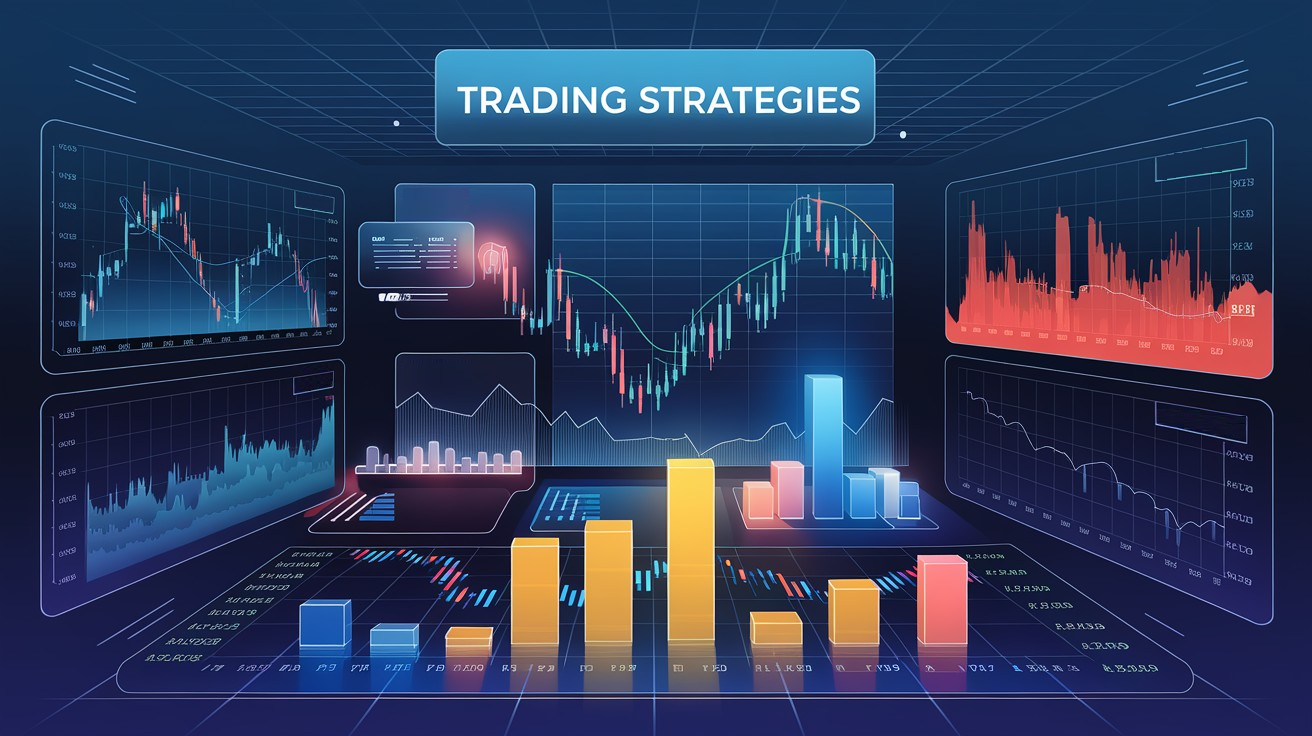
Say the exchange is chosen and the account funded. Technically it is all simple: pick a pair, say Bitcoin against the dollar, set the size, and hit buy or sell. But the technique is not the main thing here; the main thing is awareness of the entry. I never open a trade just because the price is rising and I want to catch it. I look for an entry at a level, where the reaction of large capital is visible through volume analysis, not in the middle of the chart on emotion, and I set right away where the stop will go.
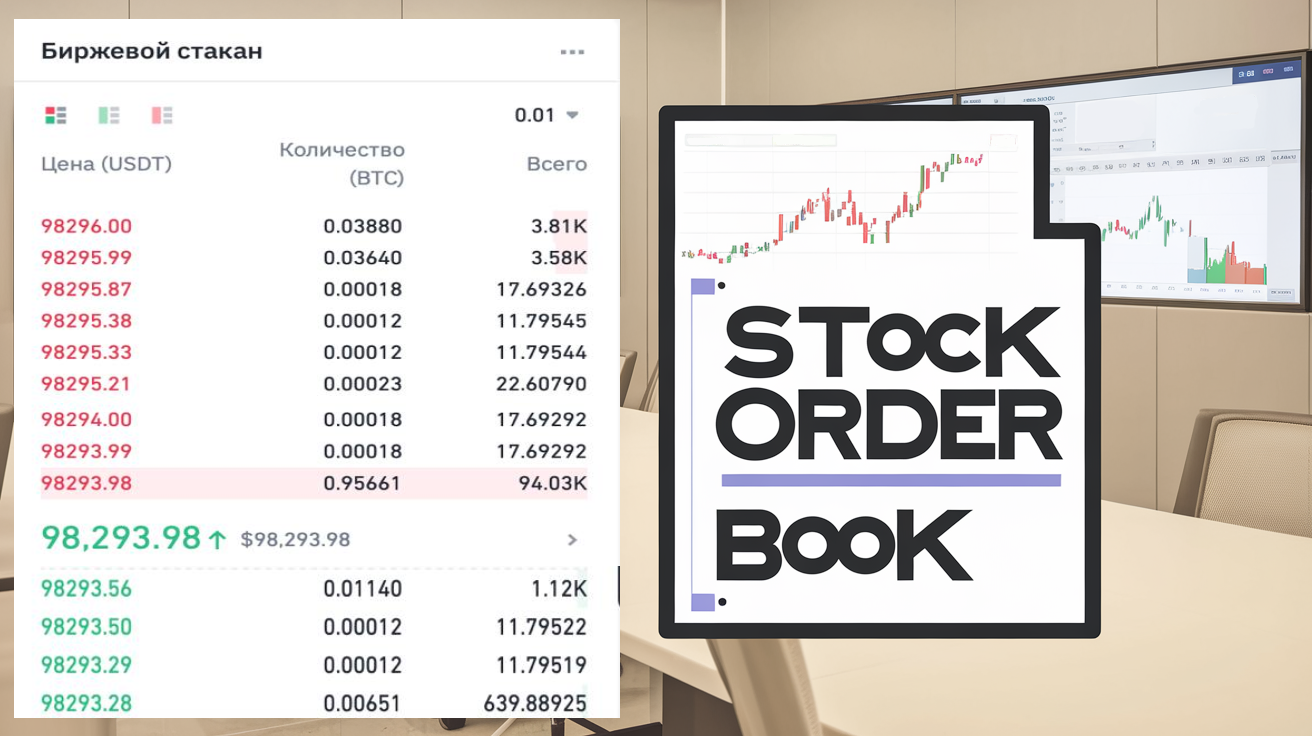
Another point about the button itself. A market order fills instantly at the current price, while a limit order sits in the book and triggers only at your price. For a deliberate entry at a level the limit order is handier: it will not let you buy in a hurry worse than you planned. So the first trade is not about the buy button but about a plan, and if you are wondering which asset to pick at the start, stick to the large and clear ones like Bitcoin.
In short: The first trade is a plan, not a button: enter at a level with a predefined stop, and use a limit order instead of rushing at market.
How to read the crypto market as a beginner
Once the first trade is behind you, a harder question comes up: how to even tell where the market is looking. Crypto market analysis to me is reading the balance between buyers and sellers, and at its base sit the same levels and volume as on any other market. Crypto only adds its own supply side: Bitcoin's capped issuance, halvings, staking, capital inflows through ETFs, and whale flows onto an exchange or off it. The main trap is that volumes on unregulated exchanges cannot be trusted, they are easily painted, so it is safer to lean on exchange data and on how price behaves at large levels. A simple example from practice: Bitcoin approaches resistance, and within an hour the volume on CME futures jumps from the usual two thousand and a bit contracts to almost seven, yet price still does not go higher. To me that is a seller's edge at the level, and buying the breakout here is risky. How to read such spikes and tell real demand from painted, I cover in the material on volume analysis.
A useful background marker is Bitcoin dominance, Bitcoin's share of the total market cap, denoted BTC.D. Most read it as a direct signal: it went up, sell alts; it went down, load up. I see it differently. It shows one thing only, where the market's money sits right now, in Bitcoin or in altcoins, and that is context for a decision, not the entry itself. How to use this metric without superstition I cover in the piece on Bitcoin dominance.
Two things beginners lose on most often. The first is manipulation: on thin liquidity, market makers in crypto move price harder than on a classic exchange and paint fake volume to lure the crowd. The second is the temptation of easy money like crypto arbitrage: on paper, buy cheaper on one exchange and sell dearer on another looks like sure money, but in real life that gap is taken in fractions of a second by the robots of large firms, and a beginner's leftover is eaten by fees. It is more honest to accept up front that there is no easy money here, and to work by a method, not by rumor.
In short: The crypto market reads through levels and volume plus its own supply side (emission, halvings, whale flows); Bitcoin dominance is a map of money, not a signal, and the main pits for a beginner are market-maker manipulation and the myth of easy arbitrage.
Demo account vs real account: where to start
And the most important advice, the one that will save you money and nerves: start with a demo account. It is a practice mode where you trade virtual money at real prices, and here you can break in your method, get used to the exchange interface, and build the habit, risking nothing.
I advise running a decent series of trades on demo and getting to a steady plus, and only then moving to real money. A real account brings in what the demo lacks, namely emotions: fear and greed. There is a psychological trap in the switch too: on demo a person is calm and disciplined, while on real money the same trade brings a tremor to the hands, and the plan falls apart. So at the start take minimal amounts, so the cost of a mistake is not frightening, and accustom yourself to real risk gradually. And here is my main takeaway over the years, and it is not advice to you personally but how I see it: a beginner loses not on the choice of exchange but on haste, when he carries real money in on the very first day and trades on emotion. I have traded for years and I know the skill of entering at a level is built only by repetition, and it is cheaper to build it on demo than on your own money. So the question of how to start is secondary; far more important is how not to drain the account at the start: method first, then demo, then a small real account with a stop. The whole base, step by step, I have gathered in the free trading course.
In short: Start on demo until a steady plus, then a small real account with a stop: people lose not on the choice of exchange but on haste and emotion.
Video course on this topic on YouTube: Crypto Trading
Frequently Asked Questions
It is a digital asset issued not by a bank but by a computer network based on a blockchain. You can exchange it directly between people, but no state stands behind it, so the value of most coins rests on demand alone.
A blockchain is a shared ledger of transfer records, a copy of which is held by many participants of the network. Decentralization means there is no single point of control, so a record is almost impossible to forge, but the usual protection is gone too.
Ordinary money has a state behind it as guarantor; crypto has only the network and demand. Crypto is not regulated by a single body and is far more volatile, and a mistaken transfer no one will reverse.
High volatility, the absence of a regulator, and a flood of meme coins and scam projects that get pumped and then delisted. So it is worth sticking to large assets and entering only with money you can afford to lose.
Look at reliability and reputation, the presence of regulation, liquidity, and the size of fees. Ads and bonuses are the last thing to go by. And do not keep all your funds on the exchange; move large amounts to a wallet.
In my experience, only a demo account. On it you break in your method with no risk to money. Move to a real account after a steady plus on demo, and start with minimal amounts.
About the Author
Author: Igor Arapov — independent researcher in the psychology of investment decisions and behavioral finance, practising trader since 2013, founder of arapov.trade, author of a trading book series (ORCID: 0009-0003-0430-778X).