The word stable does a lot of quiet lying. A stablecoin is a cryptocurrency pegged to a steady price, most often to the dollar one to one, and for a trader it works in two roles at once: a quiet harbor where you park capital between trades without withdrawing to a bank, and a trading pair through which you buy and sell the rest of crypto. But the peg really can be broken, and the UST collapse proved it.
A stablecoin sounds like something dull and safe, but in fact almost the whole turnover of the crypto market passes through it, and right here hides the risk a beginner usually doesn't think about. I myself trade mostly futures and gold, but the habit is the same for crypto: first I work out what really stands behind an instrument, and only then do I use it. With stables this matters especially, because behind coins that look like the dollar hide very different constructions and very different reliability.
In this article we'll cover:
- a stable is a coin held near the dollar, and for a trader it replaces cash and a trading pair;
- the peg is held in three ways, by real reserves, by crypto-collateral, or by an algorithm, and the last breaks first;
- USDT, USDC, and DAI have different insides, and with them a different margin of safety;
- the largest, Tether, is backed mostly by US government bonds, but its offshore status is a separate disputed question.
First, about what actually holds a stable at the one-dollar mark.
What is a stablecoin and how is the dollar peg held?
A stablecoin is a cryptocurrency whose price is pegged to a stable asset, most often to the US dollar at a rate of one to one. The point of such a coin is not to jump around like bitcoin, but to stand calmly near the dollar and serve as a unit of account.
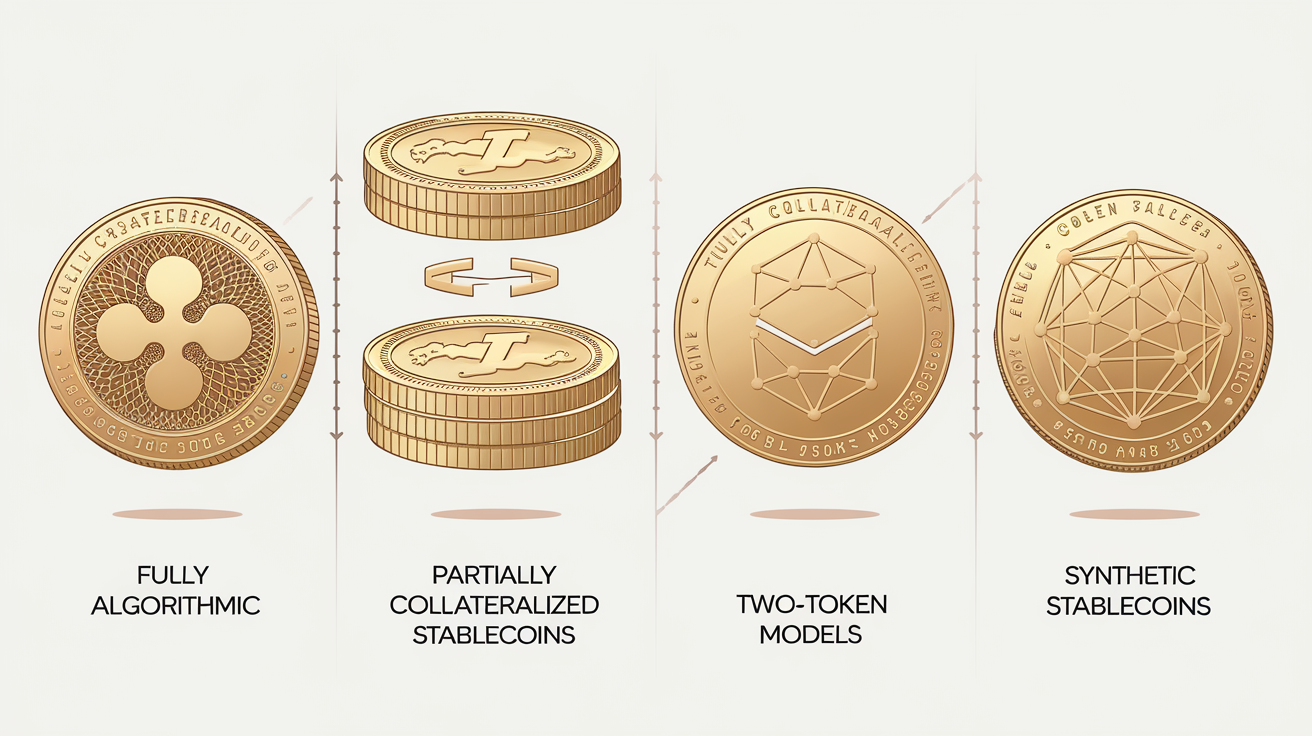
This peg can be held in three different ways, and that division matters more than it seems to a beginner. In the first case the coin is backed by real dollars and reliable assets on the issuer's accounts, and USDT and USDC go this route. In the second the backing is another cryptocurrency, locked in a smart contract with a surplus over the face value, which is how DAI is built. The third way is the trickiest: there are no real reserves at all, and the rate is held by an algorithm that issues and burns coins. The ill-fated UST worked exactly on the third scheme, and its peg was the first to fall apart. All of this is the basic brick of crypto, so if you're only entering the topic, keep crypto basics for a beginner close at hand, so the rest falls into place.
In short: A stable is a coin near the dollar at one to one; the rate is held in three ways, and the algorithmic one, with no live reserves, breaks more easily than the rest.
USDT, USDC, and DAI: how the types of stablecoins differ
Take the trio a trader meets most often, because it is in these that he holds cash and counts trades. USDT from the company Tether is the largest and most widespread stablecoin, and most trading pairs on exchanges are denominated in it. It is backed by the issuer's reserves, though the market has periodically had questions about their transparency.
USDC is issued by Circle, with dollars and quality assets behind it too, and its forte is openness: reserve reports come out regularly, and for many that is the deciding argument. DAI stands apart, a decentralized stablecoin: there is no single company behind it, and the backing is a basket of cryptocurrencies locked in smart contracts with a surplus over face value. Its convenience is its own, but so is its risk, tied to the price of the collateral crypto. To simplify, it comes out like this: USDT is taken for liquidity, USDC for transparency, DAI for decentralization, and there is no ideal one among them, each has its own compromise. For a trader, in practice, USDT is also a parking spot: you close a trade, move into the stable, and stay in crypto but already without the price swings, and you can move it between exchanges quickly and cheaply.
In short: USDT is taken for liquidity, USDC for transparency of reporting, DAI for decentralization; there is no ideal one, and for a trader USDT is also a convenient parking spot between trades.
Tether in question: what backs USDT and where the disputed points are
USDT is the stablecoin of the company Tether with a one-to-one peg to the dollar, issued back in 2014 and over time becoming the largest in the world. By 2026 there are about 186 billion tokens in circulation, and this is a backed coin: for every issued token the issuer holds real assets. The mechanics are simple: dollars come in, Tether mints the same amount of USDT, tokens are redeemed, they are burned and the dollars are returned.
By the latest reporting, more than eighty percent of Tether's reserves are invested in short-term US government bonds, the rest in gold and other instruments. This is far more transparent than a few years ago, when a lot of claims piled up against the company, including a fine from the US regulator over how it once described its reserves. A sticking point is the kind of report: for years Tether published attestations, a snapshot on a chosen day, not a full audit, and only in 2026 moved toward a proper one. There is also a purely practical point about networks: the same USDT lives at once in several blockchains, and most of the turnover falls on the Tron network because of cheap fees. When transferring, always check the network with the recipient, otherwise the coins can be lost. Normally the token costs around a dollar, but in moments of panic the price has briefly dipped lower, to around 0.95, and each time fairly quickly returned to one, and that is the depeg risk.
Then begins the disputed part, for which it is worth reading to the end. Since 2025 a dedicated stablecoin law has been in effect in the US, the GENIUS Act, and the offshore USDT does not directly fit its reserve requirements. So in early 2026 Tether issued a separate regulated coin, USAT, for the American market through the Anchorage bank, and no longer sells USDT to US retail directly. At bottom these are two different coins with different reserves: one clean and supervised for the US, the other, the main and offshore one, remaining outside American regulation. My sober view, and this is not advice but a principle I follow: I use USDT as a convenient instrument, but hold in it exactly as much as I am ready to lose, and I do not consider it absolutely safe. First understand the risk of an instrument, then use it, and where it is safer to hold the coins themselves is covered in the piece on safe crypto storage.
In short: USDT is reliable exactly as far as Tether's reserves are real: more than eighty percent in US government bonds, but the company is offshore, long published attestations rather than full audits, and for the US market it issued a separate coin, USAT.
The freeze switch: why a stablecoin is not a dollar in your pocket
Here is a point the cheerful guides skip. A centralized stablecoin like USDT or USDC is issued by a company, and that company keeps a remote control over every token. If a regulator or sanctions list demands it, the issuer can freeze, blacklist, or burn the coins at a given address, and the holder can do nothing. This is not theory: Circle has frozen USDC at sanctioned addresses, and Tether has frozen USDT linked to ransomware and law-enforcement. For an ordinary user the switch almost never fires, but it exists, and it changes what you actually hold.
A dollar bill answers to no one; a centralized stablecoin is an IOU from a private firm that can switch your balance off. So when I call a stable cash, I mean a parking spot, not something untouchable. A decentralized coin like DAI has no single freeze switch, which is its appeal, but it pays with smart-contract and collateral risk instead, no free lunch. The honest way to hold any of them is to know whose hand is on the switch and to keep in one coin only what you could lose to a depeg or a freeze. That question, more than the brand, is the real one behind a stablecoin.
In short: A centralized stablecoin is an IOU whose issuer can freeze or blacklist tokens at any address on a regulator's order, as Circle and Tether have both done; a decentralized coin like DAI removes that switch but adds smart-contract risk, so hold in one coin only what you could lose to either a depeg or a freeze.
Risks of stablecoins: the UST collapse in 2022 and why stable doesn't mean safe
The word stable lulls your vigilance, and in vain, and the best lesson here was given by the collapse of TerraUSD in May 2022. Behind UST there was not a single dollar of live reserves, its rate was held by a link with the coin LUNA: the pair was minted and burned by a set formula. While the market believed in the scheme, everything spun. But the moment trust wavered and large holders rushed for the exit, a loop unwound: traders burned UST, LUNA multiplied on the way out, its issuance swelled, and within days both coins folded almost to zero.
The scale here is worth naming plainly: by various estimates around sixty billion dollars evaporated from the market, and LUNA lost almost all its value literally in a day. The conclusion I draw from this, and this is again my position, not advice to you: algorithmic parity holds only on the crowd's trust, and trust is a fragile thing, so I hold nothing large in algo-stables at all, and I treat ordinary stables as cash: parked between trades, that's it. And even backed coins are not absolutely safe, since they depend on the issuer's reserves, its regulator, and the banking channels through which, in a crisis, a redemption might not go through. Stablecoins are not insured like a bank account, and this should be kept in mind before the first large sum. The same traps beginners most often fall into I gathered in a breakdown of risks and scam schemes in crypto, and where to even begin and whether a beginner should climb into crypto at all I show in the course section on what a beginner should trade.
In short: The UST collapse in 2022 evaporated around sixty billion in a few days; the algo-peg rests only on the crowd's faith, so I hold nothing large in it, and I treat stables as cash.
Frequently Asked Questions
It is a crypto coin deliberately held near a stable mark, usually near the dollar in a one-to-one proportion. It is needed to store and move value inside crypto without bitcoin's swings, and for a trader it serves both as a wallet for pauses and as a pair for settlements.
USDT is the largest and most liquid of all and rests on its issuer's reserves. USDC is issued by Circle, dollar-based too, but it wins on the openness of its reports. DAI stands apart: it is decentralized and relies not on dollars in a bank, but on crypto-collateral in smart contracts.
Behind it stand the issuer's live assets, and more than eighty percent of them are short US government bonds, the rest gold and other things. There is still no full guarantee, no insurance like a deposit either, so it is reasonable to hold in USDT only the share you would not be afraid to part with.
Yes, for centralized coins. The issuer of USDT or USDC keeps the ability to freeze or blacklist tokens at any address, and both Circle and Tether have done so on sanctions and law-enforcement orders. It almost never touches an ordinary user, but it means a centralized stablecoin is an IOU from a company, not untouchable cash. A decentralized coin like DAI has no single freeze switch, but carries smart-contract risk instead.
In spring 2022 the algorithmic UST broke off the dollar. Holders ran for the exit at once, a loop unwound: the token was burned, the linked LUNA swelled in volume, and within days both coins settled almost to zero. It is a textbook failure of an algorithmic scheme.
About the Author
Author: Igor Arapov — independent researcher in the psychology of investment decisions and behavioral finance, practising trader since 2013, founder of arapov.trade, author of a trading book series (ORCID: 0009-0003-0430-778X).