Built as a bridge currency for fast cross-border transfers on the Ripple payment network, XRP is, for a trader, a volatile altcoin with an unusual past. For years a regulator's lawsuit hung over it, and it was court news that moved the price most of all. By 2026 the case is over, and I suggest reading XRP as an ordinary asset, by levels and market structure.
XRP always stood apart among crypto. It was built not as digital gold but as a tool for bank transfers, and for a long time the loudest court dispute in the industry boiled around it. I have traded for many years and I approach such storylines without emotion: to me XRP is simply a volatile asset you have to be able to read on the chart. All the more so since the main regulatory fog over it has cleared by 2026. Here is what this coin is and how to approach it.
In this article we'll cover:
- XRP is the coin of the Ripple payment network, tailored for fast cross-border transfers;
- XRP, Ripple and the XRP Ledger are three different things beginners constantly confuse;
- the ledger settles without mining, through validators, which is why it is fast and cheap;
- the main price driver was long a regulator's lawsuit, and by 2026 that risk moved to volatility and centralization.
Start with what XRP is and why the Ripple network is needed at all.
What XRP is and what Ripple is used for
XRP is the cryptocurrency of the XRP Ledger blockchain, created by Ripple as a bridge currency for cross-border payments. Transfers on the network go through in a matter of seconds with a fee of fractions of a cent.
Ripple's idea differs from bitcoin's. Where bitcoin was conceived as independent digital money, XRP from the very start is aimed at banks and payment systems: through an on-demand liquidity mechanism XRP serves as the intermediate link when exchanging one currency for another, so there is no need to hold reserves in every country. There are important supply features too. XRP is not mined, all one hundred billion coins were created at launch in 2012, and a large part is locked in escrow and released gradually, up to about a billion a month. At the same time a significant share is owned by the company itself, and for that XRP is often criticized on the decentralization front. It is, at bottom, one of the large alternative blockchains with its own narrow specialization.
In short: XRP is the coin of the Ripple network, a bridge currency for fast cross-border payments with a fee of fractions of a cent; it is not mined, all one hundred billion were created at launch, and a large share is owned by the company itself, hence the disputes about decentralization.
XRP, Ripple and the XRP Ledger: what beginners mix up
Almost every newcomer trips on three names that get thrown around as if they were one thing. They are not, and the difference is worth nailing down before you read a single price chart. XRP Ledger (XRPL) is the open-source blockchain, the rails. XRP is the coin that moves on those rails, the thing you actually buy and hold. Ripple is a private company that builds payment software for banks and happens to use XRP inside some of its products. The company did not invent a religion around the coin; it built a business that leans on it.
This is where the decentralization argument lives. Ripple still holds a large block of XRP, which makes critics call the whole thing too centralized. The counterweight is that the ledger itself is run by independent validators, many with no tie to Ripple, and no single party can rewrite it alone. For me as a trader the takeaway is plain: a coin whose supply is concentrated in one company's escrow carries a different risk than a coin nobody controls, and that concentration is a fact to price in, not a detail to wave away.
In short: Ripple is the company, XRP is the coin, XRPL is the blockchain; the company holds a large stash of the coin, and that concentration is a real risk to account for.
How the XRP Ledger settles without mining
Bitcoin reaches agreement by burning electricity: miners race to solve a puzzle, and the winner writes the next block, which takes roughly ten minutes. The XRP Ledger does it differently and that is the source of its speed. Instead of miners, it uses a set of independent validators, servers run by exchanges, businesses and universities, that compare their records every few seconds. When a large majority of them agree a batch of transactions is sound, those transactions are locked in for good. No puzzle, no race, no heavy power bill.
The practical result is what the payment story is built on: transfers confirm in three to five seconds, the network can handle on the order of a few thousand transactions per second, and the fee is a fraction of a cent. This is why Ripple pitched XRP at banks rather than at gold bugs. For a trader none of this is a buy signal, but it does explain the asset's character: XRP is a fast utility coin tied to an institutional payments narrative, and that narrative, plus regulation, is what tends to move it in bursts rather than slow grinds.
In short: No mining: validators agree every few seconds, so XRP settles in three to five seconds for a fraction of a cent, which is the whole point of its payments design.
Technical analysis of XRP: key levels
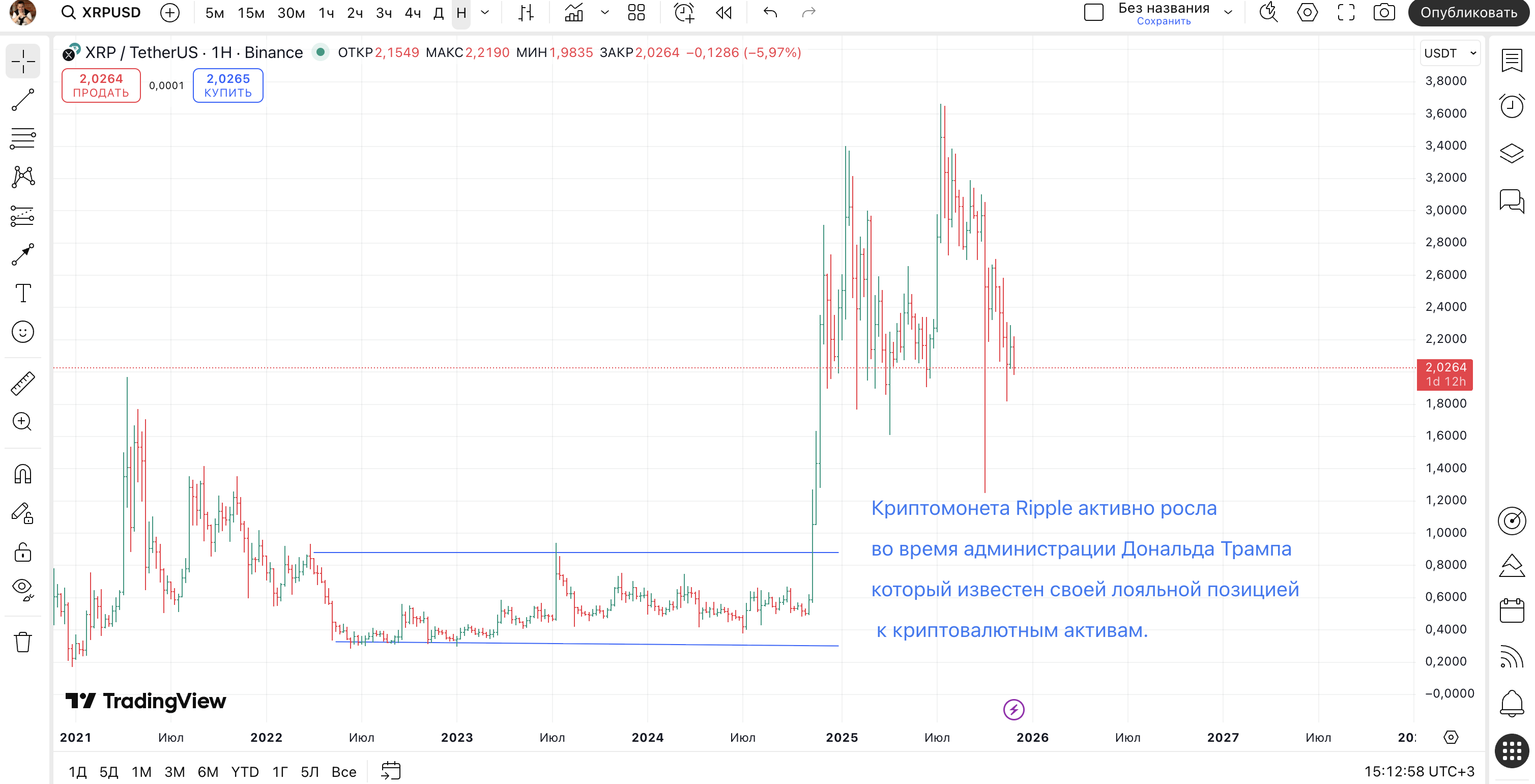
Structure comes first, the same as on any asset: where the trend runs, where it flattens, which levels price has already turned from. I invent no special approach for XRP. Over the years XRP has built up vivid psychological marks, for example one and two dollars, plus the historical peaks of 2018 and 2021 and a high of about 3.66 dollars in mid-2025. Such levels work well precisely because a lot of orders crowd around them. I build the decision on the levels themselves and the price reaction, not on indicators like moving-average crossovers, which here only lag.
A separate honest caveat about volume. In crypto the volume of unregulated exchanges cannot be trusted, it is easy to inflate, and a convenient regulated source for XRP, unlike bitcoin, is not at hand. So with XRP I lean first of all on structure and levels, and I re-check volume spikes by the price reaction: if on big volume price does not move, then the asset just changed hands. Why crypto volume needs to be treated with caution at all is covered in the article crypto market analysis, and how to build the priority change levels themselves is in the course.
In short: I invent no special approach for XRP, I read it by structure and levels: vivid psychological marks at one and two dollars and a historical high of about 3.66; I do not trust crypto-exchange volume and re-check spikes by the price reaction.
XRP regulatory risk: how the court cases moved the price
What set XRP apart as an asset was a lawsuit. In December 2020 the US regulator sued Ripple, claiming XRP was an unregistered security. For almost five years every hearing and every filing jerked the price by tens of percent. In July 2023 the court handed down a mixed ruling: XRP sales to ordinary people on public exchanges are not securities, while part of the sales to institutions did break the law. And in 2025 the case was finally closed: both sides dropped their appeals, Ripple paid a fine reduced to about fifty million dollars, and the legal uncertainty in the US went away.
For a trader this is an important shift. Earlier the main risk was the court, now there is essentially none: XRP was returned to US exchanges, and from late 2025 spot ETFs on it appeared too. But that does not mean the risk has vanished entirely, it has simply moved. The usual high volatility of an altcoin remains: after the resolution the price jumped above three dollars, then pulled back, and for 2026 XRP trades around the two-dollar area. The question of centralization also remains, because of the large share held by the company itself. So my approach is the same as before, and this is not advice to you personally: I keep the position small to suit the volatility, and I make decisions by the chart, not by the headlines. How news and regulation affect the market in general is covered in the course section on fundamental analysis, and the general logic of trading crypto is in the piece on cryptocurrency trading.
In short: For almost five years XRP's price was driven by the US regulator's lawsuit, but in 2025 the case was closed with a reduced fine and retail sales were ruled not a security; the risk has shifted from courts to volatility and centralization, so I keep the position small.
Frequently Asked Questions
It is the cryptocurrency of the Ripple network, built for fast and cheap cross-border transfers. It works as a bridge currency between different currencies. All one hundred billion coins were issued at launch, XRP is not mined.
No. Ripple is the private company that builds payment software for banks. XRP is the coin you can buy and hold. The XRP Ledger (XRPL) is the blockchain the coin lives on. Three different things people constantly mix up.
Bitcoin is independent digital money with a capped issuance and mining. XRP is tailored for bank transfers, is not mined, and a large share is owned by Ripple the company. Hence the complaints about its decentralization.
No. All one hundred billion XRP were created at launch in 2012. The ledger does not use mining; instead independent validators agree on each batch of transactions in a few seconds, which is why transfers settle so fast and cost a fraction of a cent.
In 2025 the case was closed. Both sides dropped their appeals and Ripple paid a reduced fine. It was settled that retail XRP sales on exchanges are not a security, and that removed the main regulatory risk in the US.
By market structure and key levels, not by indicators. Round psychological marks and historical extremes work well. I do not trust crypto-exchange volume, so I re-check spikes by the price reaction and keep a small position because of the volatility.
About the Author
Author: Igor Arapov — independent researcher in the psychology of investment decisions and behavioral finance, practising trader since 2013, founder of arapov.trade, author of a trading book series (ORCID: 0009-0003-0430-778X).