Averaging and the Martingale are about the same thing: pour more money into a losing trade and win it back without admitting the mistake. The math looks elegant, the account seems to save itself, and it is on exactly this beauty that beginners most often burn. Adding has only one safe form, with the trend, a small lot, and a stop, while doubling after a loss I consider a direct road to zero.
The temptation here is clear: the price has become cheaper, so the trade seems to have become more profitable, and your hand reaches out to buy more and bring down the average. I have known this feeling since the start of my path and once gave a lot of time to adding and doubling myself, until I grasped a simple thing: the market can go against you longer than your account lives. So let's break down without embellishment how the average price works, why adding against the trend and the Martingale zero the account, and in which single case averaging is still allowed.
In this article we'll cover:
- averaging shifts the average entry price, but against the trend it only delays the draining of the account;
- adding without a stop is trading without a stop, and such a loss has no ceiling;
- the Martingale grows exponentially, and any long losing streak erases the account;
- there is one safe form of adding: with the trend, a small lot, and a stop on the whole position.
I'll start with the mechanics, so you can see where that beautiful average price comes from.

What is averaging in trading and how is the average price calculated?
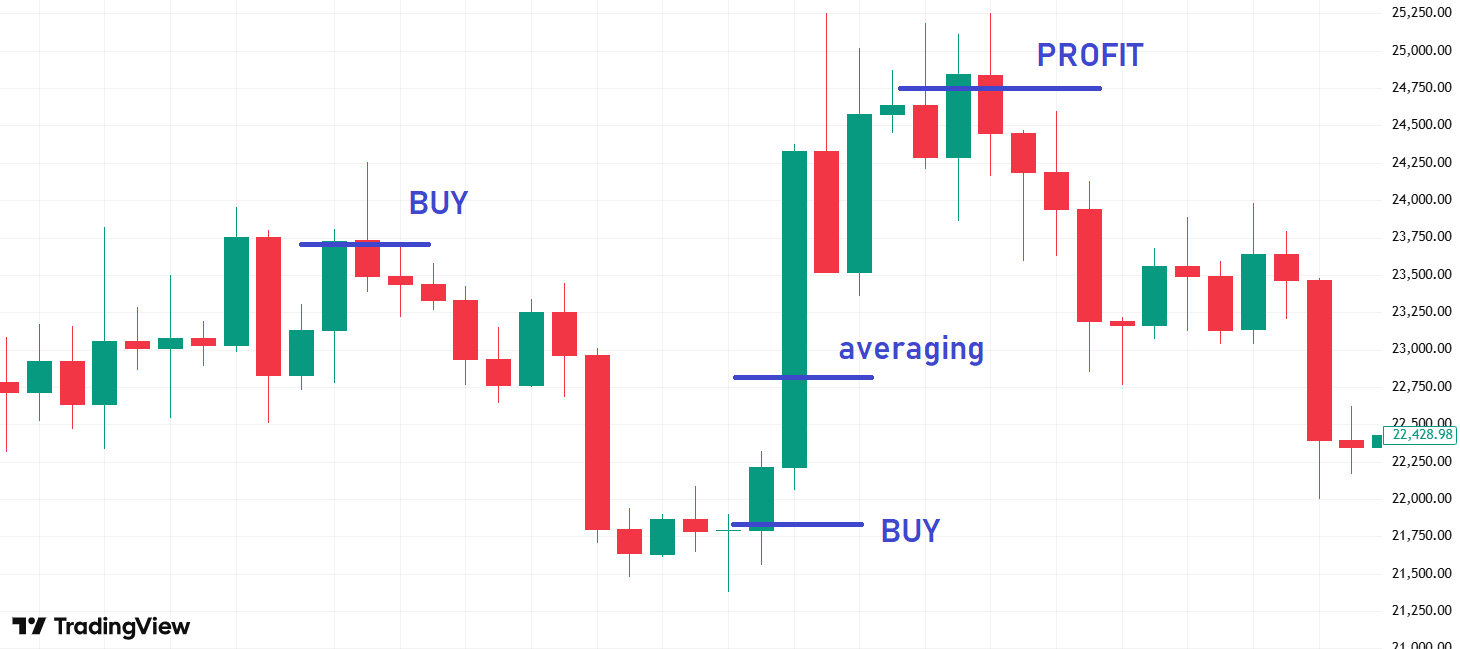
Averaging is adding to an already open position at a new price in order to shift the average entry price. Take an example I often draw: you bought one bitcoin at ten thousand, the price slid to five, you bought a second, and now you have two bitcoins with an average of seven and a half. To break even now, half the move is enough.
On the picture it looks like magic: the market seems to lie down on its own. Practice says the opposite. The trick with the average price hides one important thing: by halving the move needed to exit, you increased the volume under the loss by exactly the same factor. That is, the price for a beautiful average is a doubled bet in a trade that is still losing. Adding to a loss means putting fresh money into a position that is already going against you, and this is one of the most common beginner mistakes, which I cover separately in the course section on the typical mistakes of beginners. The average price by itself heals nothing, it only masks that the trade should have been closed long ago.
In short: Averaging moves the average price by adding to a position, but at x2 volume after a drop from 10 to 5 thousand it is just a doubled bet in an already losing trade.
Why averaging against the trend drains the account
Here is where the main trouble is buried. By adding against the trend, you buy on a weak market, and it is worth asking: why is the market falling at all? By my observations it falls not by accident, but precisely to flush out stubborn buyers. A bear trend is running, you missed the level where the pros unloaded, price drops like a stone and hands you more than one false bottom.
The technical essence is that adding without a stop is exactly trading without a stop, and such a loss has no ceiling: one stubborn position can eat the whole account. You get a double mistake: you go against the move and don't limit the risk, pouring money into a falling asset. And trends go much further than a beginner is ready to believe. From my memory, the euro against the dollar slid from about 1.40 to around 1.05 over several months in 2014 and 2015, losing more than thirty cents, and no averaging there would have saved the account under any scenario. Monetary policy turns, and a currency drives in one direction for months, not asking how many rounds you have left for adding. Here the mathematical dead-end opens up: to survive such a move and keep adding, you would have to enter with a truly tiny lot, otherwise the money runs out before the reversal. And adding to infinity is no longer trading, but simply a frozen account that does not work and waits for a miracle. How exactly adding against the trend erases the account I show on live examples in the video on averaging positions.
In short: Adding against the trend buys where the market is driving the stubborn to the slaughter, and the trend goes far: the euro slid from about 1.40 to around 1.05 over several months in 2014 and 2015, and the average price is powerless here.
The psychology of averaging: why a trader adds into a loss
The root of the problem lies deeper than technique, it is in the head. Adding to a loss is first of all a psychological defense. When a trade is in the loss, admitting the loss is painful, because it means admitting you were wrong. It is far more pleasant to tell yourself that this is not a loss but a lucky chance to buy cheaper, and so denial switches on.
Next, hope for a quick reversal kicks in, and the trader clings to the position to the last, turning a small minus into a big one. Let me show it on numbers. You took an asset at a hundred, it fell to ninety, you added at ninety, the average became ninety-five, and it seems the profit is within reach. But the fall stretches to eighty, and the loss is already noticeably heavier, because you increased the position size. So a neat drawdown swells into a hole. And the honest essence: by averaging, a person feels he is taking control, while in fact he only raises the bet in a losing hand. This is an argument not with the chart but with your own ego, which is why it is so addictive. Where else emotions hit the account and how to resist this I cover in the section on the psychology of trading.
In short: Adding to a minus is a trade not with the market but with your own ego: behind it stand denial of the mistake and hope, and they turn a drawdown to 80 into a real hole.
The Martingale method: why doubling after a loss zeros the account
The Martingale method is bet management in which, after each loss, the volume of the next trade is doubled in the hope of covering all the losses with a single win. The technique came from eighteenth-century roulette, where the player doubled the bet after every loss, and in trading it is a close relative of averaging, only meaner.
The whole substitution is in one logical error. In roulette the outcomes are independent, but on the market they are not: the price can hold a trend for a very long time, and each doubling against it does not bring the reversal closer, it only swells the position, which burns faster. Then the arithmetic kicks in. After a series of losses the volume goes exponential: one, two, four, eight, sixteen, thirty-two, sixty-four, and already on the seventh loss in a row you need a bet a hundred and twenty-eight times the starting one. On the eighth trade, to return one conditional unit you are already risking more than two hundred such units, the reward tiny, the risk monstrous. And a streak of eight to ten losses in a row is not fantasy, but ordinary variance and the mathematics of risk, and it is exactly this that zeros the account. And here is my non-obvious view over the years: the Martingale is dangerous not because it loses often, but because it wins small often. A chain of small recoveries instills a false sense of control, you feel like a genius, and then that long streak comes and with one blow erases all the accumulated plus together with the account. That is why I hold doubling after a loss as a red flag in any strategy or robot: if the Martingale is at the base, the question is not whether it will blow the account, but only when exactly.
In no healthy approach will you meet a ratio where you stake two hundred for the sake of one. And the root of the illusion is exactly the transfer of casino logic onto the market: in roulette the previous outcomes do not affect the next, but on the chart they very much do, because the price moves by trend, not by tosses of a ball. By doubling against the trend, you do not raise the chance of a reversal, you only feed the growing position, which burns the faster the longer the move holds.

In short: On the seventh loss the Martingale needs a x128 bet, and it is dangerous because it often wins small and trains you to feel in control, until one long streak erases everything.
How not to average into a loss: a plan, risk, and adding only with the trend
The good news is that there is a reliable defense against both traps, and it is a trading plan. The essence is simple: before entering you decide where the stop is, that is, you set the maximum allowable loss in advance. The price reached the stop, and you calmly exit without adding, without hopes, and without arguing with the chart. The decision is made with a cool head in advance, not in panic in the middle of the move, when emotions are off the scale and counting soberly no longer works.
The replacement for the Martingale is not another way to double, but the opposite philosophy, fixed small risk. In every trade I set aside a predefined share of the account for the loss and do not increase the bet after a loss, so a losing streak only slightly dents the account rather than zeroing it. Instead of adding to a losing idea, I fix a small minus on the stop and go look for the next clean entry at a level and with volume confirmation, not chasing a falling price. Averaging itself remains acceptable in one single form: with the trend, a small lot, and a stop on the whole position. Trading with the trend already carries a positive expectancy, and adding with the trend works only as a multiplier to it, whereas adding against the trend multiplies the loss. The basic frame of this approach, fixed risk and the priority of the stop, I lay out in the section on risk management and capital. And the main thing I learned from my own mistakes: for a beginner it is important first not to earn, but to survive. An account that survived with small risk will always live to see new opportunities, while one zeroed by adding and doubling will see nothing anymore.
In short: The plan decides in advance: the stop is hit, you exit; set a fixed small risk, and allow adding only with the trend as a multiplier to the plus, not as a rescue of a minus.
Frequently Asked Questions
It is adding to an already open position at a different price, which shifts your average entry point. You took bitcoin at ten thousand, it settled to five, you added one more, and the average dropped to seven and a half. To break even now half the move is enough, only if the adding goes against the trend, it merely postpones the draining of the account rather than canceling it.
Because you buy more on a weak market, and it often falls precisely to flush out stubborn buyers. Adding without a stop removes the ceiling from the loss, and one position can zero the account. Trends go further than it seems: the euro against the dollar slid from about 1.40 to around 1.05 over several months in 2014 and 2015, and no averaging there saved anyone.
It is doubling the volume after each loss in the hope of covering all the losses with one win. The bet flies up exponentially, one, two, four, eight and on, so that by the seventh loss in a row you are required to put up a hundred and twenty-eight times the starting sum. The market can press a position longer than the trader has money for doublings, so one drawn-out losing streak is enough to zero the account.
The reason is psychological. Admitting a loss is painful, because it means admitting a mistake, and instead of a stop, denial and hope for a reversal switch on. Adding gives a false sense of control, but in essence it is an argument not with the market but with your own ego, and it turns a small loss into a big one.
Only in one form: in the direction of the trend, with a modest volume and a mandatory stop on the whole position. That way you build up a trade that is already bringing profit on a pullback, rather than trying to drag out a sinking one. In my experience a beginner is better off forgetting about adding and first getting stronger on ordinary trading with a clear stop and careful risk.
About the Author
Author: Igor Arapov — independent researcher in the psychology of investment decisions and behavioral finance, practising trader since 2013, founder of arapov.trade, author of a trading book series (ORCID: 0009-0003-0430-778X).