The market is neutral, and people lose most often in their own heads, not on the chart. Fear makes you take profit too early and dread the entry, greed pushes you to overstay a position and risk too much, and FOMO drags you into a move that has already gone, right at the peak. The cure is not willpower but rules written in advance: a system, a trading plan and discipline that take the emotion out of the moment of the trade.
Inside every beginner sits an enemy who wants to get rich very fast, and it is exactly that enemy who switches the emotions on at the worst moment. I once earned my first forty dollars myself, almost several times over in a couple of weeks, and decided I had cracked the code, and then reality took its due. I have traded for many years, and here is what I see year after year: the charts are the same, the volumes and levels are the same, and beginners blow their accounts on emotion just as they always did. That is why psychology, for me, is not a soft optional topic but a good half of the result.
In this article, we'll cover:
- the market is neutral: the same chart can be traded like a casino or like a business, and the difference is in the head;
- fear, greed and euphoria push you to break your own rules, and tilt blows the account in one evening;
- FOMO wakes you at the very top of a move, when the pros are already taking profit;
- cognitive biases are predictable errors of thinking, and they hit more quietly than emotions.
Let's start with why the head decides more in trading than the strategy.
Why trading psychology beats strategy
The market does not punish you for not knowing indicators, it punishes you for predictable errors of thinking. You can read a chart perfectly and still lose steadily if, at the moment of the trade, the decision is made by emotion rather than reason. That is exactly why I say psychology is a good half of the result, and the other half is a system that, without a cold head, does not work anyway.
Behind this lies a simple picture of the market. Price is moved by two forces, professional money and the crowd, and professional money takes from the crowd precisely through its emotions. The crowd buys on euphoria and sells on fear, that is, does the exact opposite of what big capital does. I look at this through volume: it shows where the strong participants really stand, not where the crowd is looking. And here is what matters to grasp from the start: your main opponent on the market is not another trader and not a market maker, but your own fear and greed. As long as they run your entries and exits, any strategy will bleed out.
In short: The market punishes not ignorance of indicators but predictable errors of thinking: professional money takes from the crowd through its emotions, and as long as fear and greed rule decisions, any system bleeds out.
Gambling or business: two ways to trade the same chart
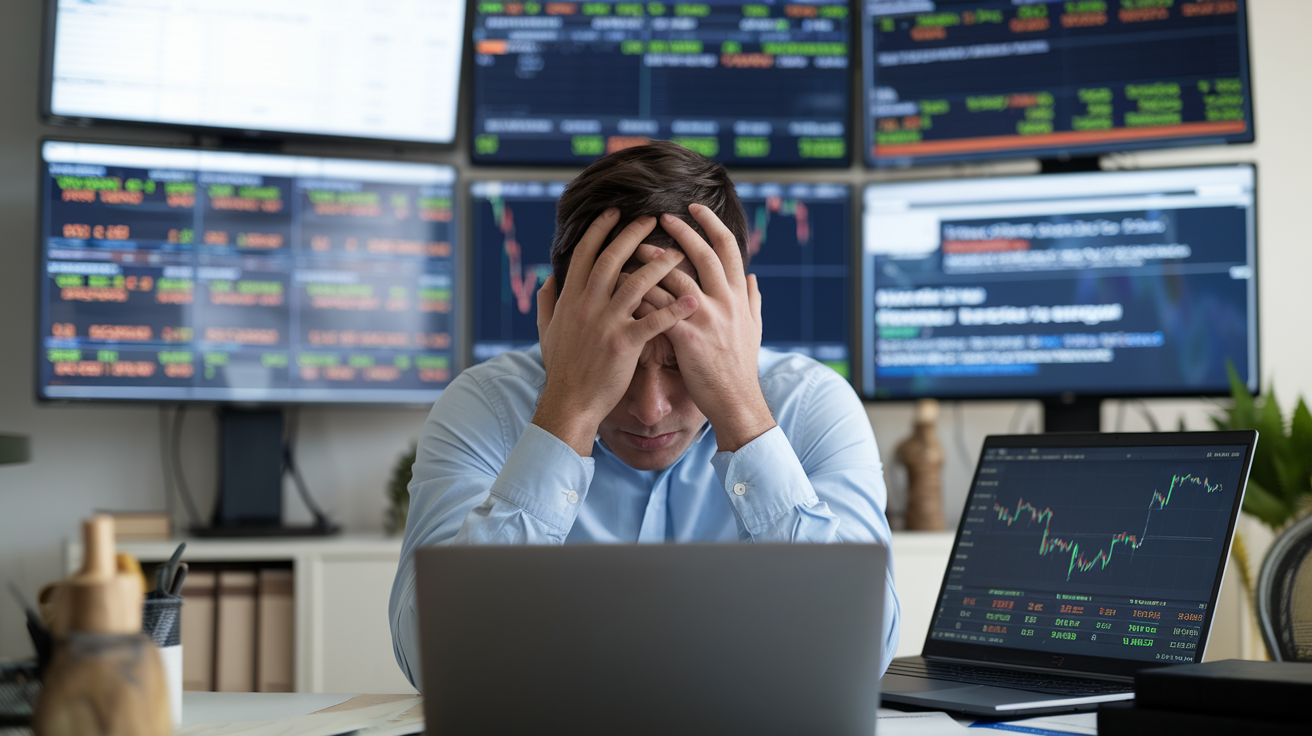
Trading discipline is the habit of acting strictly by rules written in advance rather than by momentary feelings, and it is exactly what separates business from gambling. The gambler wants to get rich fast, enters on emotion and without a system. The professional treats trading as a boring long-term business: system, discipline, risk management.
The crux is that the difference lies not in the instrument and not in the market, but in the head. The very same chart, one trades like a casino and another like a business. Behind that stands cold mathematics. If you open a trade without understanding why you entered and where you will exit, you automatically end up on the side of negative expectancy, and over the distance that guarantees losing money. A system, by contrast, gives positive expectancy: the professional, like the casino, keeps the maths on his side, while the gambler keeps it against himself. The business approach rests on three things: a system with positive expectancy, risk of a small share of the account, and a risk-to-reward ratio. I keep it at 1:3, that is, for every dollar risked I aim for at least three, but that is my approach, not advice to you. How to count a system's expectancy I show in the course section on mathematical expectancy, and how to build the trading plan itself we cover separately.
In short: The same chart can be traded like a casino or like a business, and the head decides it: an entry with no understanding of why puts you on negative expectancy, while a system with small risk and a ratio from 1:3 keeps the maths in the black.
Fear, greed and euphoria: a trader's core emotions
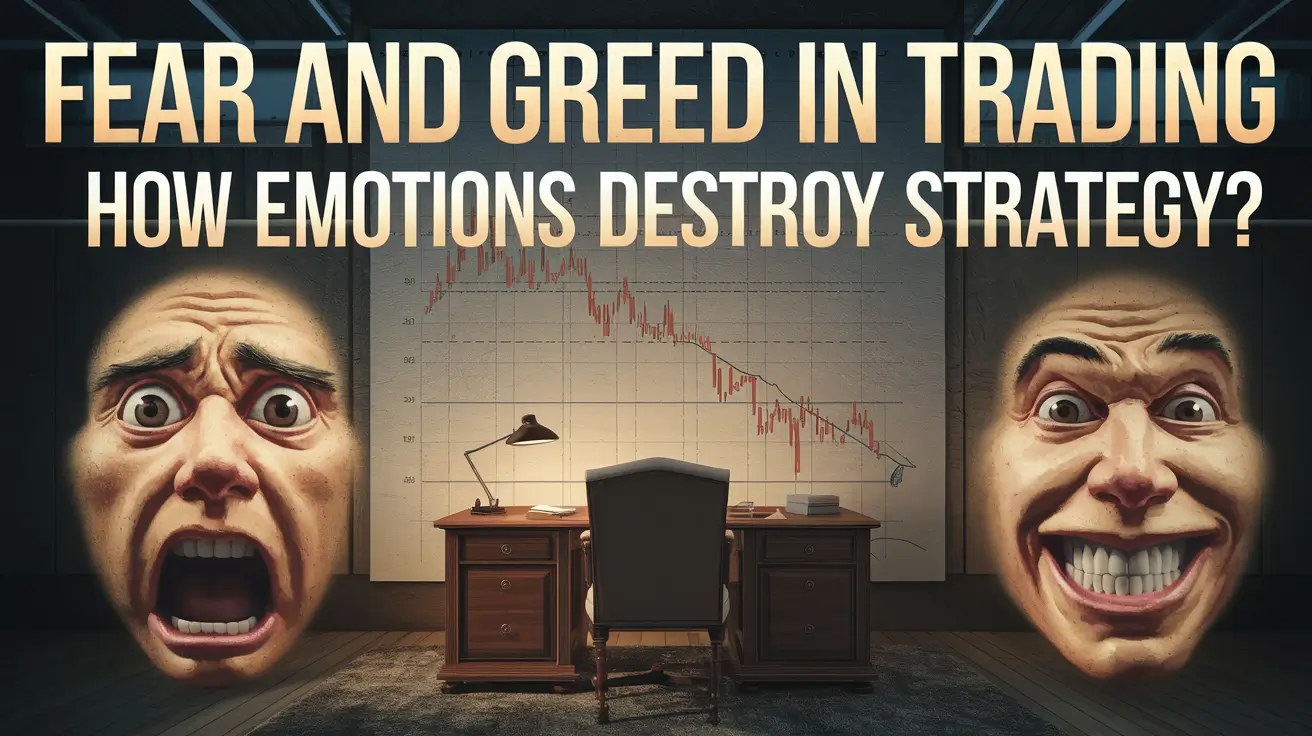
Loss aversion is built so that the pain of a loss is felt more strongly than the joy of an equal gain. Because of it a trader jumps out of a winning trade early, afraid to lose what was earned, and conversely holds a losing one hoping the price returns. Greed works as the mirror: it pushes you to overstay a position, build up risk and chase one big trade. These two always travel as a pair and swing the trader from one extreme to the other. Euphoria stands apart: after a run of wins comes a feeling of invincibility, and a person abandons their own rules right before the reversal.
The most dangerous state is tilt, when after a painful loss a trader loses control and starts taking revenge on the market, opening trade after trade just to win it back fast. That is exactly how an account is blown in one evening, I have seen it many times. Tilt, greed and fear are the three emotions that will bury any result if they are not kept in check. Year after year I see the same path with fear in beginners. At first a person fears nothing at all: overstates risk, averages down a loss, trades without a system, climbs against the trend. And why? Because the crash has not happened yet. Then comes the first serious blow-up, and the pendulum flies to the other extreme: the beginner starts fearing everything, fears to open a trade, fears to set a stop, because they no longer trust themselves. Both the fear and the former recklessness get in the way equally, and the cure for both is one and the same, rules instead of feelings. How averaging down a losing position grows out of these same emotions I cover in the piece on averaging down and martingale, and how fear and greed work in the moment I show in the course.
In short: Fear and greed swing you from extreme to extreme, and tilt after a loss blows the account in an evening; a beginner travels from total recklessness to fearing every trade, and the cure for both edges is one, rules instead of feelings.
FOMO: the fear of missing out and buying the top
FOMO is the fear of missing out, a state of sharp anxiety at the thought of a missed chance to earn. The name comes from the English Fear of Missing Out.
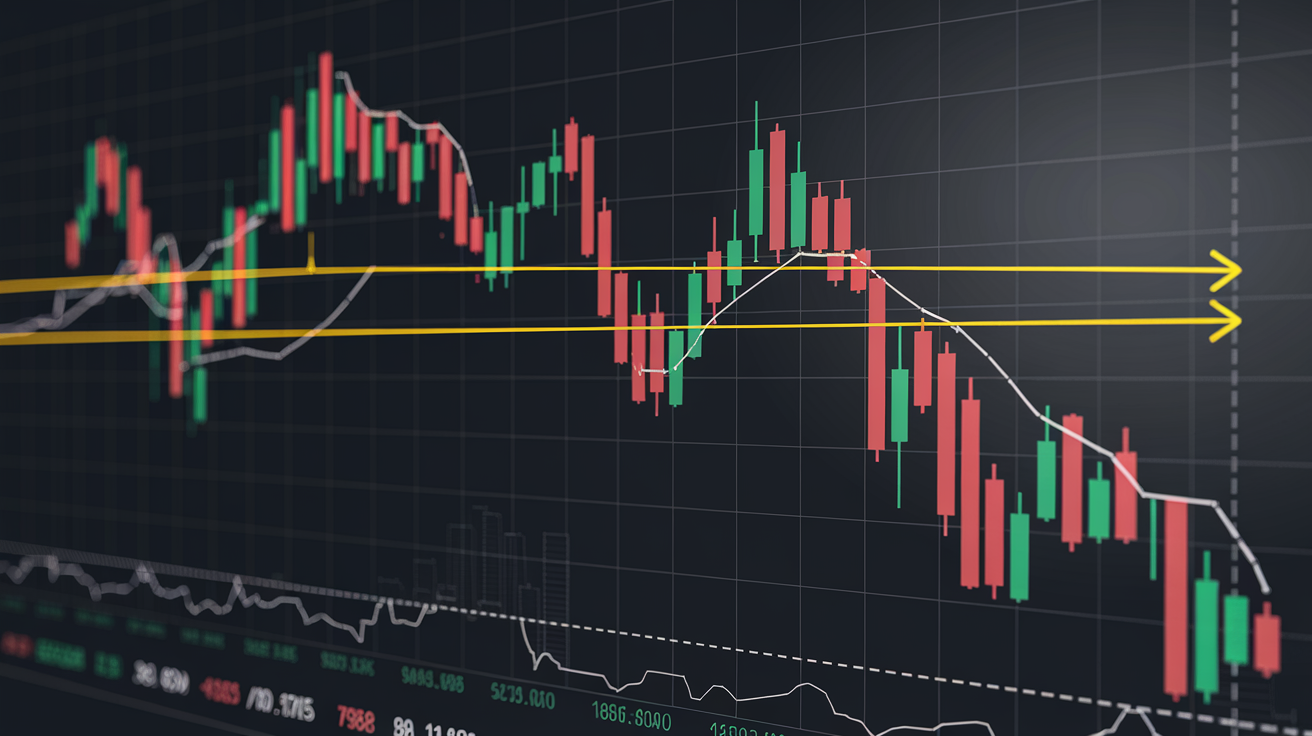
The mechanics are simple. A person sees an asset shoot up, and the brain sends an alarm signal. There is no real loss, yet the missed profit still feels like a genuine one, because we feel a loss more sharply than an equal gain. Then social media kicks in: other people's screenshots of huge gains and their delighted posts create the illusion that everyone around is getting rich except you, and you want to chase the train at any cost. The most insidious part is that the fear fires exactly when the move is almost over. Price has rocketed up, every feed has written about it, and only now, at the very top, does the beginner decide to enter, while professional money at that very moment is taking profit and handing it to the latecomers. A live example came with bitcoin: in autumn 2025 it set a record above 126 thousand dollars, trumpeted everywhere, and by early 2026 it had nearly halved, down to around 60 thousand, and those who bought on euphoria ended up deep in the red. I treat the market like buses: one has left, the next will come soon, and there is no need to run after the departing one under its wheels. The market owes no one anything, it existed before you and will exist tomorrow.
In short: FOMO wakes you at the very top, when the pros take profit and hand it to the latecomers: bitcoin from 126 down to 60 thousand showed it in pure form, and the best remedy is to remember that the market owes no one anything and the next bus will come.
Crowd psychology and big capital: who profits from whom
Now the main thing this is all worth understanding for. The market is not a casino against the house, but a constant transfer of money from the emotional crowd to cold capital. Professional money does not out-play the crowd with better indicators, it simply stands on the other side of its fear and greed. And the most interesting part is that the crowd's emotions fall exactly onto the phases of the market that I read by volume.
See how it looks. After a long fall, the crowd panic-sells assets at the bottom just to stop the pain of the loss. That is precisely when big capital calmly builds a position at a cheap price, and on the chart this shows as the accumulation phase. Then, after a long rise, euphoria and FOMO grip the crowd, it buys at the highs believing in endless growth. And at exactly that moment the same big capital quietly hands it what it gathered at the bottom, this is the distribution phase. So fear and greed are not only your personal enemies, they are also the commodity on which those who keep a cold head earn. The logic of big capital and these phases I cover in the Smart Money guide.
This is why, for me, psychology and method are two sides of one coin. I read volume not for pretty lines but to see exactly where the crowd is handing over money, and to stand on the side of capital rather than the panicking mass. Technical analysis shows what is happening on the chart, while an understanding of crowd psychology explains why it is happening. Without the second, the first easily slides into guessing. This is my position and how I work, not a ready recipe, but it is exactly this that keeps me on the right side of the market more often than the wrong one.
In short: The market transfers money from the emotional crowd to cold capital: the crowd sells in fear at the bottom (accumulation) and buys in euphoria at the top (distribution), while big capital stands on the other side of its emotions, so for me psychology and method are one whole.
Cognitive biases: the predictable errors in a trader's thinking
Cognitive biases are systematic errors of thinking that make a trader assess the market and their own trades unobjectively and take irrational decisions. This is not a one-off slip but built-in patterns inherited by evolution: in ordinary life they help you decide fast, while on the market they slip you a convenient picture instead of a cold assessment of probabilities.
The most dangerous part is that biases work unnoticed by the person themselves. The trader is sure they reason logically, while in fact they have already fitted the facts to the desired conclusion, and this makes biases more treacherous than plain emotions like fear, which are at least visible. A few come up more often than the rest. Loss aversion is the most destructive: a loss is held hoping for a bounce, profit is cut early. Confirmation bias makes you seek only what supports an already open position and ignore the opposite. The anchoring effect ties you to the first figure: you bought at a hundred and consider a hundred the fair price, though the market decided otherwise long ago. Here too is the herd effect, which drives you to buy in the general frenzy, and overconfidence after a run of wins, which pushes you to raise risk right before the reversal. All of them lead to one thing, rising risk and a drift from the plan. Fighting them with willpower is useless, because they are part of how the brain is built, but noticing and sidestepping them is quite doable.
Let's take the main biases one by one, so you recognise them in yourself. Loss aversion is when the pain of a loss is lived more strongly than the joy of an equal gain, and because of it a trader cuts profit early and holds a loss to the last. Confirmation bias makes you seek only the news and signals that confirm an already open position, and not notice the opposite. Anchoring ties you to the entry price as if it were fair, though the market cares nothing for it. The sunk-cost fallacy pushes you to average down a loss on the principle of "I've already put in so much, I must add more", and that is exactly how a small minus turns into a blown account. The recency effect, after a run of luck, persuades you it will always be so, while the gambler's fallacy whispers the opposite: five times down in a row, so now it is surely up. And crowning it all is overconfidence, when after a couple of profitable trades the hand reaches to raise risk on its own.
In short: Biases hit more quietly than emotions: most of all loss aversion (the loss is held, the profit cut), plus confirmation bias, the anchor to the entry price, the herd effect and overconfidence; willpower won't remove them, you can only notice and sidestep them.
The psychology of drawdown and losing streaks
Worth a separate look is the thing that breaks even the disciplined, a run of trades. A drawdown is a temporary decline of the account after a chain of losing trades, and here hides the main psychological trap. Several losses in a row are not a breakage of the system and not a signal that the method has stopped working. Even for a strategy profitable over the distance, losing streaks are absolutely normal, ordinary statistics rather than catastrophe. Even in a system where more than half the trades win, a run of four or five losses in a row sooner or later happens, and that is the maths of probability, not a reason to break your rules. The trouble is that the head takes them as a personal defeat.
Then the familiar scenario kicks in. After a painful drawdown the trader wants to win it back at once, raises risk, enters with no setup, and tilt turns a normal run of losses into a blown account. The mirror trap waits on a winning streak: after several lucky trades comes a swelled head, it seems the market is cracked, risk grows, and one big trade hands back everything it gave. Both pits are about the same thing, judging yourself by the result of a single trade instead of the process.
The cure is not willpower but maths and limits set in advance. If you keep risk per trade to a small share of the account, any normal drawdown will not knock you out either financially or emotionally, and the urge to win it back simply finds no fuel. Position size and allowable risk I cover in the piece on risk management. And a trade journal helps separate the main thing: did I lose because of a bad decision, or was it a good trade with an unlucky outcome. These are different things, and it is fairer to judge yourself by the quality of decisions than by the random result.
There is also a quiet way to kill a profitable system without changing a single entry rule: jerking position size around by mood. After a couple of losses the hand cuts risk to token fractions, after a winning streak it inflates instead, and the big bet ends up landing on the losing trade while the micro bet lands on the winner. The edge of a system rests on the risk per trade being identical; make it float with emotion and the positive expectancy stops working, even if the signals themselves stay the same. I keep size constant for exactly this reason: not because it feels calmer, but because only this way does the math survive, the math the whole thing was built for.
In short: A losing streak is the normal statistics of a profitable system, not a breakage; after a drawdown you are pulled to win it back, after wins comes a swelled head, and both pits are about judging yourself by one trade; the cure is small risk per trade and a journal that separates a bad decision from an unlucky outcome.
How to keep emotions in check: plan, journal and discipline
The main secret is that emotions cannot be beaten in the moment, they must be taken out of the equation in advance. This is done with a trading plan, where entries, exits, the stop and the risk per trade are written down before you have opened the terminal. When the decision is already made by the rules and with a cold head, in the moment of the trade the emotions simply have nothing to switch on, and a bias finds it harder to interfere.
There is a plain mechanic of the mind behind this, not willpower. Under stress the part of the prefrontal cortex that handles cold calculation works worse, and arguing with yourself in the moment is almost useless: the emotion is faster. So I do not try to beat fear or greed with willpower, I remove the decision from the hot spot. Entry, stop and size are set in advance, and when price reaches the level there is nothing left to choose, only to execute. Mark Douglas, in Trading in the Zone, framed this through probabilistic thinking: the outcome of a single trade is unknown, yet over a series the edge plays out on its own, while the craving for certainty right here and now is exactly what pushes you into mistakes. Architecture over willpower: not heroics in the moment, but rules taken with a cold head that there is nothing left to break once the moment comes.
After that, simple supports do the work. A stop-loss removes the tormenting hope and does not let a loss grow. Small risk per trade lowers its emotional weight: if you risk a small share of the account, there is little to fear. A trade journal stops you rewriting history after the fact and shows real statistics instead of flattered memories. A daily trade limit and a pause after a painful loss keep you from breaking into revenge and catching tilt. And it is worth changing the very attitude to losses: a loss is not a failure but an ordinary cost line, as in any business. It sounds boring, I know, but in all these years I have met nothing more workable, and this is not advice to you but how I act myself. I cover this topic through my own path and mistakes in the video where I explain why fear is the beginner's main barrier and why psychology beats strategy: how to work with the fear of trading.
In short: Emotions can't be beaten in the moment, they are taken out of the equation in advance: a trading plan, a stop, small risk, a journal, a trade limit and a pause after a loss instead of revenge, plus seeing a loss as a cost line, not a failure.
How a trader's psychology changes with experience
Psychology is not static, it moves through predictable stages, and I went through them myself. At the start a thrill-seeking gambler sits inside, wanting to get rich very fast. I too began with that thrill: the first random profit is lived as caught multiples, and the market looks like a cash machine whose code you have finally guessed. This is the stage of recklessness, when risk does not frighten simply because the beginner has not yet seen how fast it all turns against them.
Then comes the first run of painful losses, and the pendulum flies to the other extreme. Thrill gives way to fear: the hand shakes over the button, entry is daunting, and the trader either freezes or grabs at every indicator in a row in search of that one grail. For me this stage stretched over a couple of years spent sifting through indicators and books, until the picture came together through volume and a mentor. This is the most dangerous valley, and it is here that most quit, because they hunt a magic button instead of changing the very approach to decisions.
And only further on comes maturity, and it looks unexpectedly boring. The emotions do not go anywhere, but their weight falls, since decisions are already made in advance by the plan, and risk per trade is small. A trade stops being an event that sets the heart pounding and becomes a line in the journal. The paradox is that good trading is closer to boredom than to adrenaline, and it is exactly that even, almost mechanical state that is the sign psychology has caught up with technique. This path cannot be jumped over, it can only be shortened, and the crisis drawdowns taught me more than any theory.
In short: Psychology moves through stages: a beginner's recklessness, fear after the first losses with thrashing in search of a grail, and finally maturity, where a trade is a line in the journal rather than adrenaline; the path can't be jumped, only shortened, and drawdowns teach harder than theory.
Video course on this topic on YouTube: Trading Psychology
Frequently asked questions
Yes, because even a technically sound trader loses money when trades are executed on emotion. The market is neutral; people mostly lose inside their own heads, as fear, greed and haste break any system. So working on psychology is not a soft optional topic but a good half of the result.
Fear makes you exit profit early and hold a loss hoping it returns. Greed mirrors it, pushing you to overstay a position and risk too much. They work as a pair and swing the trader between extremes, and after a painful loss tilt and the urge to win it all back often follow.
FOMO is the fear of missing a profit when price runs fast without you. It fires when the move is almost over and everyone has already written about it, so the beginner enters at the very top, while professional money is taking profit and handing it to the latecomers.
Tilt is the state where, after a painful loss, a trader loses control and starts taking revenge on the market, opening trade after trade just to win it back fast. That is exactly how an account is blown in one evening. The best defence is a pause after a loss and a hard limit on trades.
You don't beat emotions in the moment, you take them out of the equation in advance with a trading plan: entries, exits, stop and risk written down before the terminal is open. The stop removes painful hope, small risk lowers fear, and a journal plus a pause after a loss keep you from breaking into revenge trading.
Fear of entry is almost always about too much risk. Cut the share of the account per trade to one where the loss does not scare you, and write the entry, stop and target in advance, so the plan decides, not emotion. When the cost of a loss is small and the scenario is set, the hand stops shaking over the button, and practising on a demo account adds calm through habit.
About the Author
Author: Igor Arapov — independent researcher in the psychology of investment decisions and behavioral finance, practising trader since 2013, founder of arapov.trade, author of a trading book series (ORCID: 0009-0003-0430-778X).