Most traders draw order blocks all over the chart, then wonder why price walks straight through them. A real order block is rare. It only appears where big money ran out of counterparties and had to push a large order through the market, and the giveaway is a spike in volume, not a tidy rectangle.
There is a lot of noise around order blocks, especially in crypto, where they get sold as a finished holy grail. I use the order block myself as a strong reference, but I add two filters to it, volume and a higher timeframe, and below I show where I refuse to enter without them.
In this article we'll cover:
- an order block marks the zone where large capital built a position, the last opposing candle right before a strong impulse;
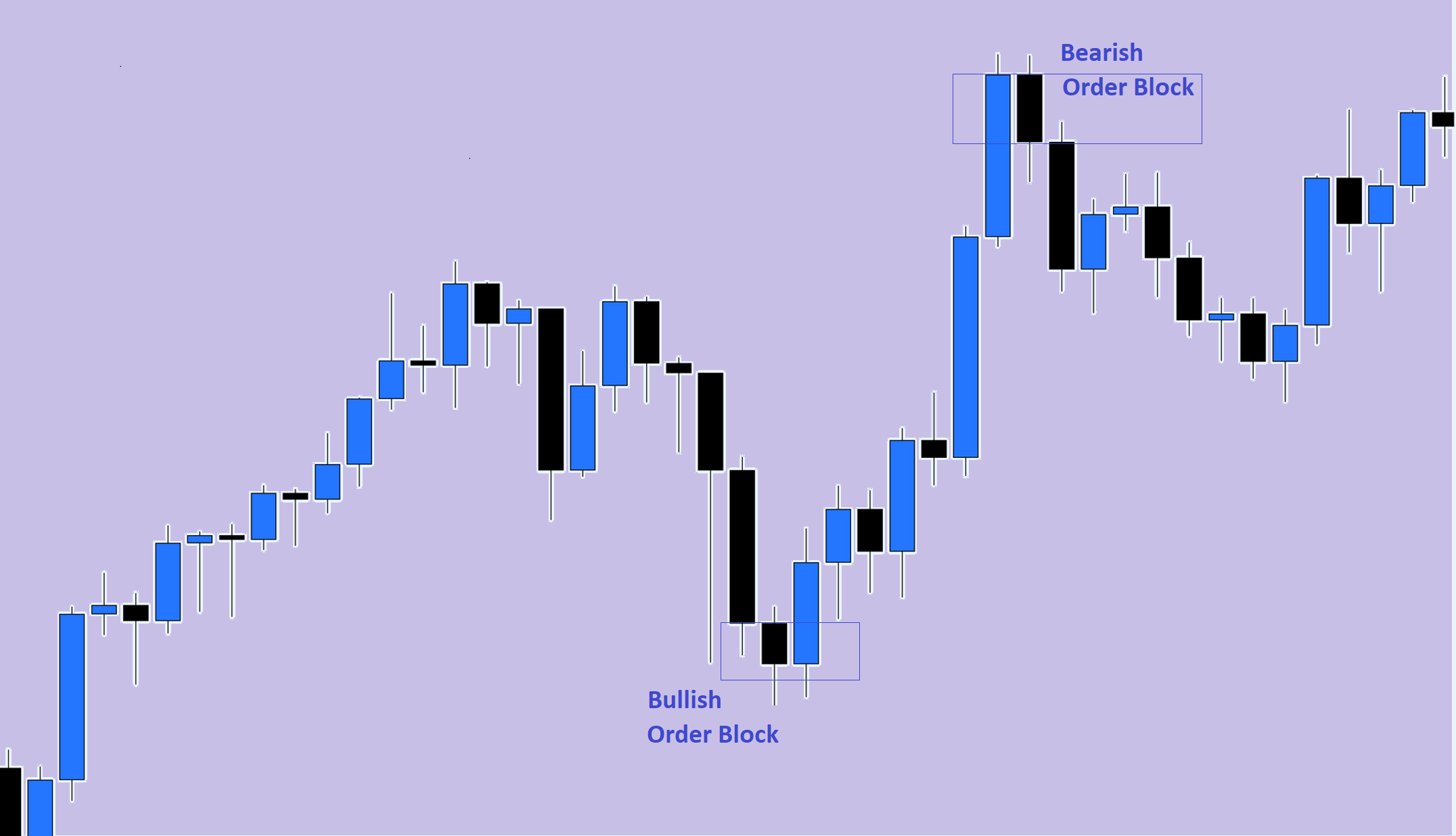
- a bullish order block is the last bearish candle before a move up, a bearish one is the last bullish candle before a move down;
- price often returns to the order block, and that return is what traders use as an entry;
- a rectangle without a volume spike is just a candle, so volume is the filter that separates a real block from a drawing.
Let's start with the definition and with what actually separates an order block from any other candle on the chart.
What is an order block in trading?
An order block is a price zone where large capital, institutions and market makers, built a significant position before a strong impulsive move. On the chart it usually shows up as the last opposing candle before the push: the last down candle before a sharp rally, or the last up candle before a sharp drop. The fingerprint where smart money stepped into the market.
The mechanics are simple once you see them. Big players normally hide their size behind limit orders so they don't move price against themselves. An order block is the opposite: there weren't enough sellers to fill a huge buy, so the order had to be pushed through at market, and that pushing creates the sharp impulse. The presence of large capital shows up as a burst of volume, the effort and result principle. The full Smart Money picture sits in the Smart Money guide.
They split into two kinds. A bullish order block is the last bearish candle before a strong rise, a demand zone where big money loaded longs. A bearish one is the last bullish candle before a strong fall, where they loaded shorts. There is also mitigation: the block is considered to have done its job once price comes back into it and bounces, confirming the interest. The same block rarely fires twice: once price has tagged it, most of the orders there are already filled.
Right next to an order block you almost always find an imbalance, also called an FVG, a price gap the impulse leaves behind. It is the area the market skipped so fast that price often returns later to close it. A strong order block and an imbalance sitting together reinforce each other: the block shows where the position was built, the gap confirms the exit was fast and heavy. I read that pair as one zone of interest, not two separate things.
It also helps to know the reverse case, when the block fails to hold. If price slices clean through, the old block often flips role: a broken demand zone starts acting as resistance, a supply zone as support. That flipped block is called a breaker block. No magic, just a level changing priority: traders who loaded inside the original block and ended up underwater close their loss on the retrace, and their orders shove the market the other way.
And here is the link that explains why the block works at all, not just how to mark it. The order block is the same accumulation zone Wyckoff described: the last opposing candle before the impulse sits exactly where large capital was finishing its build, in essence in the area of the spring and the last point of support on the way out of the range. That is why the block holds price: unfilled volume of the large player is left inside it, and when price returns he tops up the position, filling those orders. SMC calls this mitigation, but to me it is the old Wyckoff logic under a new name, and I read the block not as a coloured zone from a script but as a footprint of accumulation in volume.
In short: An order block is the last opposing candle before an impulse, the footprint of a position built by big money: bullish is a demand zone, bearish a supply zone, and a volume spike is what confirms it.
How to find an order block on a chart
Finding one is a simple routine that still takes practice. First, spot a strong impulsive move that broke the previous market structure. Second, mark the last opposing candle right before that impulse: for longs the last down candle before the rally, for shorts the last up candle before the drop. Third, check the context, the block should sit at a meaningful level with clear volume.
A common question is how an order block differs from a plain level. An ordinary support or resistance line is often psychological or historical, just a line where price once turned. An order block is a specific zone tied to real activity from large capital, which makes it tighter than a bare line. Hunt for it on higher timeframes, daily and four-hour, where there is less noise.
There is one detail without which the order block produces a lot of false blocks. The impulse after the block has to break structure, meaning it takes out the previous significant high for longs or low for shorts. That break is called a break of structure, and it is what separates a genuine reversal block from a random candle before ordinary chop. Once I have the block, I tighten its borders: the candle body is the core of the zone, the long wicks I treat as a buffer. A narrow, clean block is more reliable than a wide blurry one that swallows half the screen.
Then there is timeframe nesting. I find the large block on the daily or four-hour, then refine the entry inside it on a lower timeframe, where I can see how price reacts to the zone. Often a small fifteen-minute block sits inside the big daily one, and entering from it gives an even tighter stop, less risk without losing the quality of the zone.
Here is what it looks like on a chart. Price sat in a tight range, then one large candle broke the top and flew up, taking out the previous high, so it broke structure. I go back to where the impulse started and find the last down candle before that push, and its body is the bullish order block. I mark the zone by the candle body, check whether the impulse carried a volume spike, and wait for the return. If price comes back and reacts, I have an entry with a short stop under the block. If it slices straight through, I stay out.
In short: A real block sits in front of an impulse that breaks structure, and the core of the zone is the candle body: find it on the higher timeframe, refine the entry on a lower one.
How to trade order blocks: entry, stop-loss and target
The trade is built on the return. You wait for price to come back to the order block and test the zone. Inside it you look for confirmation, a reaction in price or a small structure shift your way, and only then enter along that original impulse. A bullish block is traded long, a bearish one short. Entering right inside the zone gives a short stop, the main edge of the approach.
The stop goes beyond the far edge of the block, past its extreme: if price gets there, the idea has already failed. The target sits at the next level or wherever liquidity is parked, and the risk-to-reward is usually kept from 1 to 3. One thing to keep straight: an order block is not a holy grail, price runs through it sometimes, so an entry without volume confirmation is risky.
Let me put it in the order I actually use. First I wait for price to come back to the block, ideally after it swept some liquidity on the way, a false break through equal highs or lows. That strengthens the case: big money collected the stops first, then came to defend its zone. Inside the block I watch the reaction, a reversal candle, a volume spike, a small structure shift my way. Only then do I enter, stop beyond the far edge of the zone, target toward the opposite liquidity, the nearest pool of stops the market will reach for.
The combination I rate highest is a block with a liquidity sweep. Picture stops piled under equal lows, price spikes through them, collects the liquidity, then turns and leaves a bullish order block on that very spike. A return to that block is two things lining up in one spot: collected liquidity and a position-building zone. In my experience those are the entries that work most often, because there is clear mechanics behind them, not just a pretty rectangle.
And here is what an order block does not do. It doesn't tell you when price will return, sometimes a couple of candles, sometimes weeks. It doesn't guarantee a bounce, price can pass straight through, so a stop is mandatory. And it doesn't work detached from the trend, a block along the higher trend is more reliable than a counter-trend one used to catch a reversal out of nowhere. I keep those three limits in mind and don't ask the tool for more than it can give.
The common mistakes are the same every time. Jumping into every rectangle that looks like a block, with no break of structure and no volume. Taking a block against a strong trend, hoping to catch a reversal on flat ground. Putting the stop inside the zone, too tight, where ordinary noise knocks it out. Trading blocks on low timeframes, where there are dozens and almost all are empty. Each is cured by the same thing, patience and the habit of waiting for confirmation instead of a drawing.
Now my own take. A clean order block shows up far less often than the articles suggest. ...the exception, not the rule. A true order block forms only when there weren't enough counterparties and the large order had to be pushed through at market. That is why clean zones are rare, and the eye needs training. So my main rule: without volume any rectangle can be called an order block, but it is just a candle. I don't enter a zone without confirmation, I see the burst of activity and the reaction first, then enter. And to be plain, the order block is not a grail. Price runs through it regularly, so my stop is always beyond the far edge of the zone. I don't trade order blocks on news at all, too much random movement there. This is not advice for you personally, it is how I act myself. I am not talking you out of order blocks, the opposite, it is a strong reference I use too, I just add two filters, volume and a higher timeframe. Why the volume spike matters is explained by the effort and result principle, and how the order block fits into the wider work with levels is covered in the free course. How an order block looks and forms on a live chart, I show on gold in the video on what an order block is and how to trade it.
In short: Enter on the return into the block after a liquidity sweep and a reaction with volume, stop beyond the far edge of the zone, target at the opposite pool, risk-to-reward from 1 to 3.
Frequently Asked Questions
It is a price zone where large capital built a position before a strong move, usually the last opposing candle right before the impulse. Think of it as the footprint of smart money on the chart. Price often comes back to that zone, which is why traders use it as a reference for entries.
Find a strong move up that broke structure, then mark the last bearish candle right before that rally. That candle is the bullish order block, a demand zone price can return to. It is stronger when it sits on a solid level and is backed by volume.
A plain level is often psychological or historical, just a line on the chart. An order block is tied to real activity from large capital and is a specific zone rather than a single line. That makes it tighter than a bare level, but it needs volume to confirm.
An order block is the candle or zone where large capital built a position. An imbalance, or FVG, is the price gap between candles that the market tends to fill later. Traders often use them together: the block marks the zone of interest, the gap next to it strengthens the case.
Beyond the far edge of the block, past its extreme. If price gets there, the zone failed and the idea is off. Entering inside the zone is exactly what lets you keep the stop short and aim the target at the next level with a risk-to-reward from 1 to 3.
About the Author
Author: Igor Arapov — independent researcher in the psychology of investment decisions and behavioral finance, practising trader since 2013, founder of arapov.trade, author of a trading book series (ORCID: 0009-0003-0430-778X).