How the Relative Strength Index Works
RSI is an oscillator that judges the strength of a fresh price move and boils it down to a number from 0 to 100. A reading above 70 is usually called overbought, below 30 oversold. Only those zones give no command to trade: in a firm trend price holds overbought for weeks. That is why RSI is valuable as a hint about the state of the market, not as a button to enter.
RSI is one of those indicators a beginner runs into first. It is simple, it is visual, and it breeds the illusion that the market has finally become predictable: 70 flashed, sell; 30 flashed, buy. Were it that easy, there would be no losers left on the market long ago. Here it is without the fuss: what RSI actually shows and where it lets you down.
In this article we'll cover:
- RSI measures the relative strength of rises and falls over a period and gives a number from 0 to 100
- the 70 and 30 zones are not a reversal signal but only a reason to take a closer look, and shorting a trend on overbought is especially dangerous
- RSI divergence can be a useful hint that a move is weakening, but as a lone signal it is unreliable
- by my observations RSI is worth subordinating to the analysis of levels and volume, rather than building an entry on a single indicator
To start with, here is how this number on the scale is even born.
What is the RSI (Relative Strength Index)?
RSI (Relative Strength Index) is an oscillator that sets the average size of price's rise against the average size of its fall over a chosen period and turns them into a number from 0 to 100. Its author, Welles Wilder, described it in 1978 in the book New Concepts in Technical Trading Systems. The standard calculation period is 14 candles, recommended by the creator himself.
The idea is straightforward: buyers press harder and RSI crawls toward the top of the scale, sellers outweigh them and it slides down. The 50 line cuts the scale in two and roughly shows whose side the advantage is on right now. By my observations it is exactly this central line that is more informative than the hyped 70 and 30 zones, because it is about the balance of forces rather than a promised reversal.
In short: RSI is an oscillator from 0 to 100 built from the average rise and fall over 14 candles; the central 50 line says more about the balance of forces than the 70 and 30 zones do.
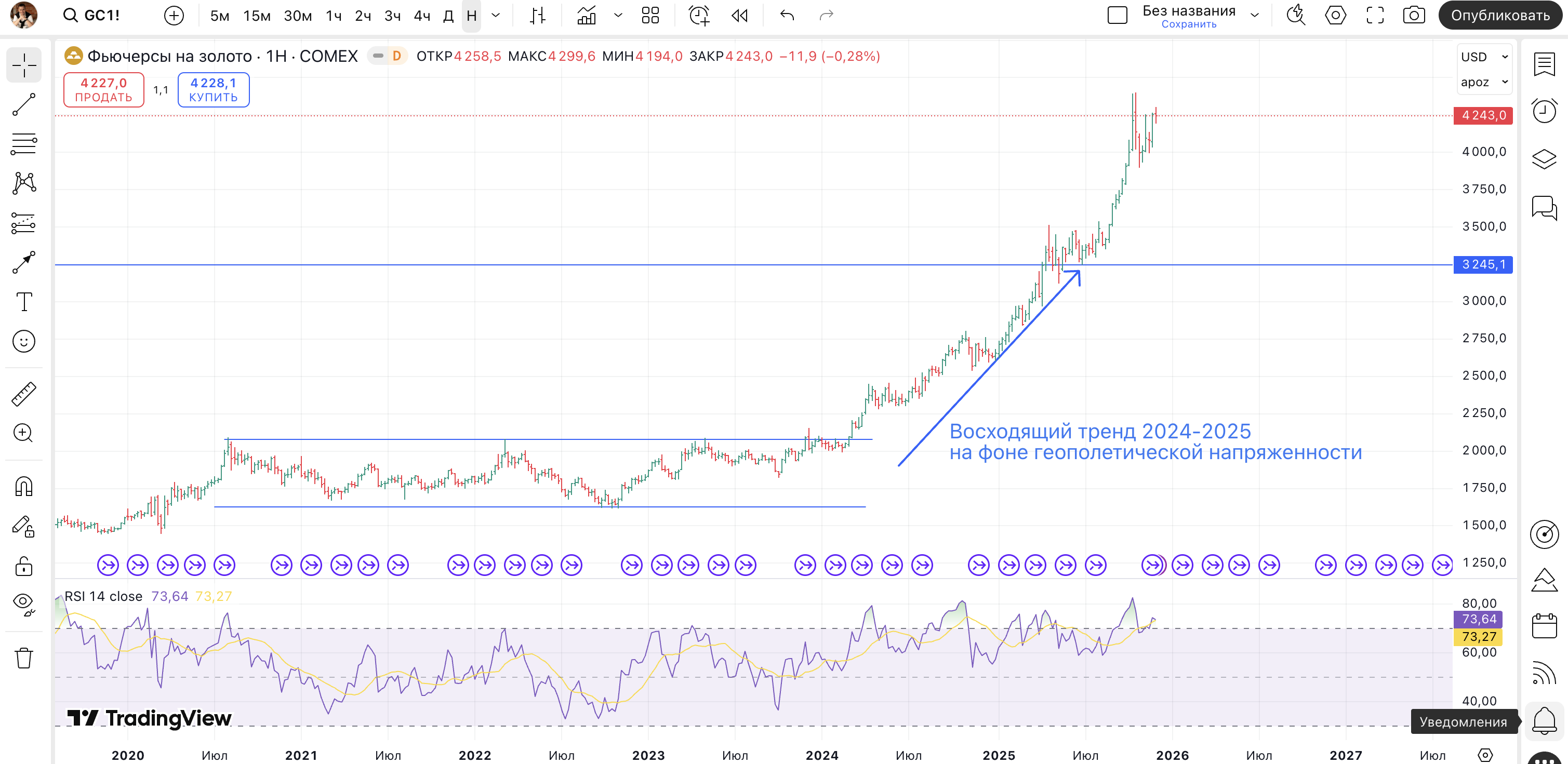
RSI signals: overbought above 70 and oversold below 30
The classic reading goes like this: above 70 the asset is overbought and supposedly time to sell, below 30 oversold and time to buy. On a calm range it sometimes fires. But here is the main trap for a beginner, and it is worth burning into memory: in a strong trend RSI can hold above 70 for a very long time while price climbs the whole while. Whoever shorts merely because of overbought stands against the trend again and again and loses.
So the grown-up approach is to trade not the entry into the zone but the exit from it, with confirmation from price. Even that is not enough for me. Far more honest is to first work out whether it is a trend or a range right now, and only then glance at RSI. In a range the extreme zones make sense; in a trend it is wiser to ignore them or shift the markers. Any signal I always check against a level and against whether volume is coming in there.
In short: The 70 and 30 zones are not a command: in a trend RSI hangs in the extreme zone for a long time; first decide trend or range, then check the signal against a level and volume.
RSI divergence: how to use it to spot a reversal
A divergence is a disagreement between price and the indicator. Bullish divergence: price sets a new low, but RSI draws a higher low, which means the sellers' pressure is weakening. The bearish one mirrors it: a new high on price, but the RSI peak is below the previous one, the buyers are running out of breath. I lay out the mechanics in detail in the material on divergence on indicators.
Divergence really can come in handy: it often hints in advance that a move is losing traction. But by my observations it is flimsy as a lone signal. The disagreement sometimes drags on while price still pushes the old way. I take it only together with a priority-change level and volume: when divergence coincides with the approach to a strong level and a burst of volume, now we are talking. On its own it is only a reason to be wary.
In short: Divergence hints at a move fading, but solo it is unreliable and drags on; it works only in tandem with a strong level and an inflow of volume.
RSI limitations: why the indicator gives false signals
The root of all the false signals is one. RSI is calculated from already closed candles, so by its nature it lags and retells the past. It has no idea about the news, about a large player, about the level on the left. Hence the frequent misfires: in a trend it calls against the trend, in a range it twitches at every ripple.
That is no reason to throw RSI out. I keep it as a decent gauge of state but a poor generator of entries. Put it next to other trading indicators or next to the MACD indicator, and the ailment common to them all comes out: derivation from price. What actually cures that ailment I have gathered in the course section on indicators.
In short: RSI is calculated from closed candles and lags, knowing nothing of the news or a large player; it is a good thermometer of state but a poor generator of entries.
How to actually use RSI: settings, the 50-line, and combinations
Since people mostly ask about settings, the short answer is that the default of 14 is the sane place to start, and there is no magic number that scrubs out the false signals. A shorter period like 7 or 9 reacts faster and fires more often, which simply means more noise; a longer one like 21 smooths the picture and shows only the bigger momentum shifts. One adjustment that has real logic behind it: in a strong trend you can widen the bands from 70/30 to 80/20, so the indicator flags only genuine extremes instead of every ripple. None of this turns RSI into a money machine, it only fits the tool to your horizon.
The use that actually holds up depends on whether the market trends or ranges. In a range the extremes do their job: near 70 the move is stretched up, near 30 stretched down, and a mean-reversion read makes sense, best of all where it lines up with a level. In a trend the extremes mislead you, so the honest tool is the 50 line: while RSI keeps holding above 50 the buyers are in control and you look for continuation rather than a top, and below 50 it is the sellers' tape. That is the same idea seasoned traders lean on, and it fits how I work: RSI at most confirms the side, while the entry itself comes from a level and a burst of volume. Put plainly, treat RSI as a filter that agrees or disagrees with your read of the chart, never as the trigger by itself.
In short: Start at 14 and don't chase a magic period; widen the bands to 80/20 in strong trends; mean-revert from 70/30 only in a range, lean on the 50 line for trend continuation, and let a level and volume make the actual entry.
My experience
By my observations, RSI does the most harm to beginners, since it looks like a ready answer, which it is not at all. When I started, I cycled through RSI periods in search of the perfect setting that would filter out the false signals. There simply is none. There is no magic value, there is an understanding of context.
My view is unfamiliar to many: RSI is worth keeping on the chart not for signals but as a thermometer of the market's state. The balance of forces, the fading of an impulse, all of that it shows respectably. And the entry I look for by a level and volume, because that is where the intent of a large participant comes through. If you want to try RSI, start with the default period of 14 and do not short a trend just because of the number 70 or 30. This is not a recommendation to you, it is the principle I hold to myself.
In short: There is no perfect RSI setting, there is context; keep it as a thermometer of state and look for the entry by a level and volume, not trading 70 and 30 against the trend.
Frequently asked questions
With a number from 0 to 100 it shows who is pushing harder on the market right now, buyers or sellers. The higher the value, the more aggressively buying ran over the last stretch; the lower it is, the harder sellers leaned on price.
A value above 70 is called overbought, below 30 oversold. It does not command a trade. In a strong trend RSI hangs in the extreme zone for a long while, so trading against the trend by it is risky.
No, and this is the costliest beginner mistake. Overbought only means upward momentum is stretched, not that a reversal is due. In a strong uptrend RSI can hold above 70 for weeks while price keeps climbing, so shorting purely because of an extreme reading is a fast way to lose money against the trend.
The standard is 14, recommended by the author himself. A shorter period spawns more signals and noise, a longer one smooths the picture out. A beginner is calmer starting with the default 14 and not chasing a magic setting.
In a range the 70 and 30 extremes make sense for a mean-reversion read, ideally only where they line up with a level. In a trend the extremes mislead, so the 50 line is the honest tool: while RSI holds above 50 buyers control the tape and you look for continuation, below 50 it is the sellers' side. The actual entry still comes from a level and volume.
Divergence hints at a fading move, but as a sole signal it is unreliable and can drag on for a long time. In my experience it is worth taking only in tandem with a level and volume.
About the Author
Author: Igor Arapov — independent researcher in the psychology of investment decisions and behavioral finance, practising trader since 2013, founder of arapov.trade, author of a trading book series (ORCID: 0009-0003-0430-778X).