Trading and investing are two different ways to make money on the market. A trader buys cheaper and sells dearer, earning on the price difference over a short horizon. An investor buys an asset for the long haul and earns on its growth and on cash flow, dividends for example. I'm a trader myself, but for most beginners investing is calmer and simpler. What you choose depends on how much time, nerve and capital you're ready to put in.
One of a beginner's biggest questions is which to become, a trader or an investor. People mix the two up, though they're different professions and different ways of life. I'm a trader, I've been at it for years, and for me it's everyday work, but that doesn't mean my path suits everyone. Investing is quieter, takes less time and nerve, and for many it's the more sensible call. Let's sort out the fundamental difference, how goals and horizons split, which one really pays more, how risk control is built in each, and how to pick the path that fits you.
In this article we'll cover:
- trading is earning on the price difference over the short term, investing is growing capital for the long haul;
- the investor earns a return of its own, dividends and growth, the trader has only the price difference;
- trading's higher ceiling is the price of time, skill and risk, not a gift, and most who chase it lose;
- in my experience risk in trading is active and fast, so there's no doing it without a stop and control.
Let's start with the most important thing: how the two approaches differ at the root.
What's the key difference between trading and investing?
Trading is active dealing where you earn on the price difference: buy cheaper, sell dearer and lock in profit over a short stretch. Investing works differently: you buy an asset for the long run and hold it, counting on its growth and on cash flow like dividends.
The deepest difference I'd put like this. Investing earns a return of its own: the company works, grows, pays dividends, and your capital grows along with it. In trading there's no such return: your income is only the price difference you've taken from the market. So trading is work, while investing is closer to ownership. Where to even begin I cover in the material on the basics of trading, and I show the difference vividly in the video on the key difference between trading and investing.
A simple picture makes it click. You buy a share at 200. A trader might sell it at 215 a few days later and pocket the 15, then look for the next move. An investor buys the same share, holds it for years, collects the dividends, and counts on the business itself to push the price toward 400. Same paper, two completely different jobs: one harvests the swing, the other owns the growth.
The deeper split is not only in the horizon but in what a person actually looks at. A trader reads the chart: price, volume and levels, that is technical analysis, because over a horizon of minutes to weeks a company's earnings report decides nothing, while current supply and demand set the move. An investor instead leans on the fundamentals: business profit, dividends, the state of the economy, since they hold the asset for years and pay for a future cash flow rather than today's candle. These are two different tools for two different jobs, and the argument over which one is right is pointless. I myself stand on the side of the chart and volume: to me the news is already priced in, so I read the footprint of money, not the annual report. But if your horizon is years, the fundamental view sits closer to you, and technical analysis is secondary.
In short: Trading is earning on the price difference over a short stretch, while investing is buying an asset for the long run for growth and dividends; investing earns a return of its own, trading only the price difference.
Trader vs investor: different goals and time horizons
A trader and an investor live by different clocks, and from that everything else follows. A trader works a short horizon, from minutes to weeks. It's active daily work, a profession in effect, demanding attention to the chart, discipline and constant control, and the trader's goal is a regular income on the price difference. An investor plays the long game: a horizon from months to decades, with a calmer task, to protect and grow capital, including shielding it from inflation. They keep an eye on which way the wind blows, watching the fundamentals and the economy's growth rather than every candle.
Hence the money side too. Trading's return is potentially higher, but also less stable and far harder won. There's a piece on earning in trading about that. There's a nuance here: a high potential return isn't a gift but the price of the time, skill and risk a trader puts in every day. The investor pays for a calmer, more predictable return with time: their capital grows more slowly, but without the daily strain at the screen.
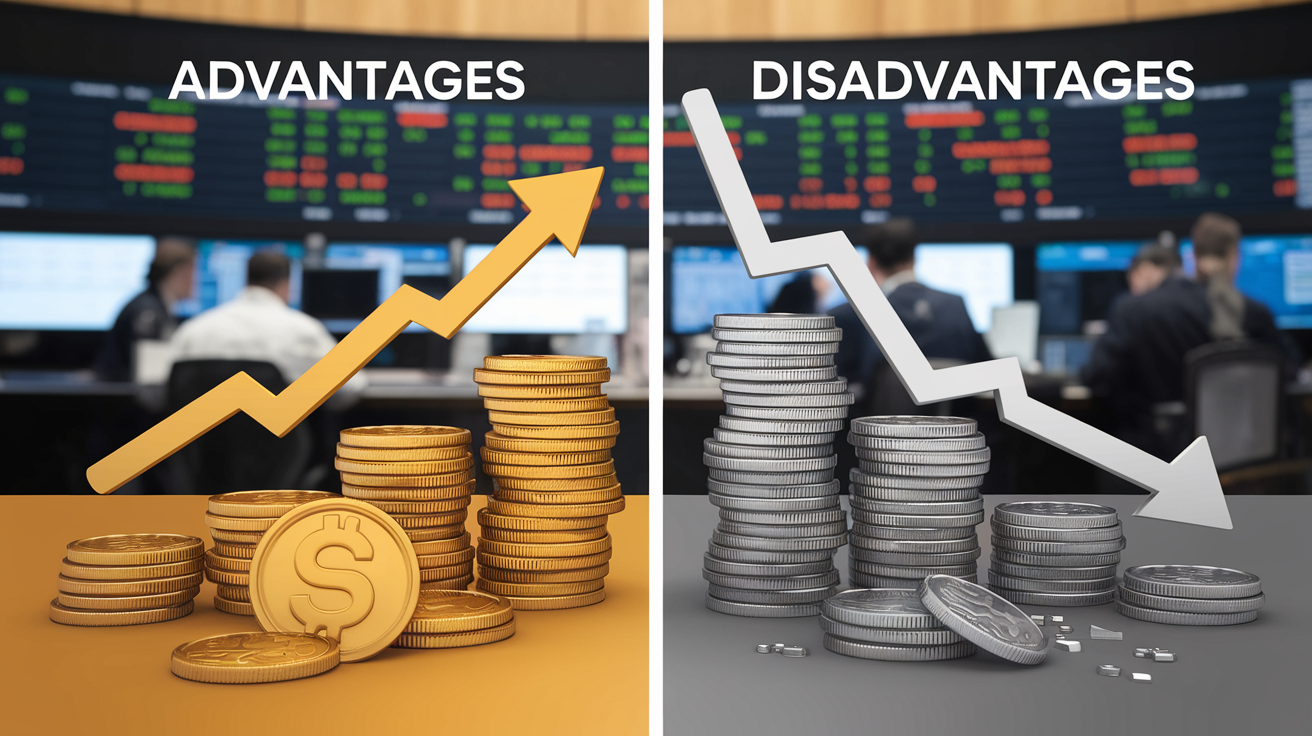
In short: A trader works a short horizon for a regular income and it's a daily profession, while an investor plays the long game to protect and grow capital; trading's high return is the price of time, skill and risk.
Which is more profitable: trading or investing?
Almost everyone asks which one pays more, and the honest answer disappoints the people chasing fast money. A long-term investor in a broad index has historically pulled something like 10 to 15 percent a year, and that is the calm, realistic base. Trading has a higher ceiling, a strong month can beat a whole year of investing, but that ceiling is not a gift. It is the price of the time, the skill and the risk a trader carries every single day, and most who reach for it never get there.
Here's the part the glossy ads leave out. Out of a hundred trades, roughly thirty will be losers even on a working system, that is simply how probability works, and without a stop on every trade that dispersion quietly burns the deposit. I've watched it for years: the person who treats trading like a slot machine for monthly returns of dozens of percent is, in practice, doomed to give the money back. So when someone promises you steady triple-digit returns, read it as a red flag, not an opportunity. Investing pays less per year, but it pays without that daily strain, and for most people that's the trade worth taking.
In short: Investing's calm base is roughly 10 to 15 percent a year; trading's ceiling is higher but it's payment for time, skill and risk, and without a stop the dispersion eats the account.
Risk control in trading vs investing
Now the most practical part: risk is built differently in the two approaches. In trading the risk is active and fast: a trade can turn against you in minutes, so the protection here is mechanical, a mandatory stop-loss on every trade and a small risk per trade. Without that, trading turns into a casino, and I say it over and over. In investing the risk is slower and stretched over time, and the tools are different: diversification, that is spreading across different assets, and a long horizon that smooths out drawdowns. Passive instruments like exchange-traded funds (ETFs), which you buy on the exchange, are exactly about that calm approach.
By the way, the choice doesn't have to be rigid: many combine the two, holding the bulk of their capital in long-term investments and actively trading with a small part. That's a sensible hybrid, if you have the time and discipline for both roles. My stance is simple: in both, what earns money isn't guessing but risk control, the tools are just different. This isn't advice aimed at you personally, it's what I see in practice: a beginner who isn't ready to sit at the chart every day finds it calmer to start with investing. And how to count an acceptable position size and risk I break down in the course.
In short: In trading the risk is fast and the protection mechanical, a stop on every trade and small risk, while in investing the risk is slow and diversification and a long horizon do the work; in both it's risk control that earns, not guessing.
Trading or investing: which to choose, and can you combine them?
So which one is yours, and do you even have to pick just one? My rule on the market is simple: see it first, then join, don't guess. The same logic fits this choice. If you're not ready to sit at the chart every day, read levels and hold discipline through a losing streak, investing is the calmer place to start: you put money into a diversified basket and let time do the work. If the daily work pulls at you, the screen, the fast decisions, and you can stomach the risk, trading is a profession you can grow into, but only with control. There's no universal right answer here, there's the answer that fits your time and temperament.
And the choice isn't binary. Plenty of people run both, holding the bulk of capital in long-term investments and trading actively with a small slice they can afford to lose. That hybrid is sensible if you have the time and the discipline for two roles at once. What I wouldn't do is jump straight into leveraged trading with the whole account because someone flashed a screenshot of a big month. Start from where your time and nerve actually are, not from where the ad wants you to be, and let the path grow from there.
In short: If you can't sit at the chart daily, start calmer with investing; if the daily work pulls you and you can control risk, trade; many sensibly do both, trading only with a slice they can afford to lose.
Frequently asked questions
A trader earns on the price difference over a short horizon, buying cheaper and selling dearer. An investor buys an asset for the long run and earns on its growth and cash flow like dividends. Trading is work; investing is closer to ownership.
Trading's return is potentially higher, but less stable and harder won; it's the price of time, skill and risk. Investing grows more slowly but calmer, historically around 10 to 15 percent a year on a broad index. Which is more profitable depends on how much time and nerve you're ready to put in.
Mostly yes. A trader reads the chart, price, volume and levels, that is technical analysis, because over a short horizon current supply and demand set the move. An investor leans on the fundamentals, business profit, dividends and the economy, because they hold for years.
In trading the risk is fast and the protection mechanical: a stop-loss and a small risk per trade. In investing the risk is slow, and diversification and a long horizon that smooths out drawdowns do the work. But risk control is needed in both.
Yes, over a short horizon the risk is faster and concentrated, so a trade can turn against you in minutes. Investing spreads the risk across time and assets, but it isn't risk-free either: a deep market drawdown can hit a portfolio hard. The protection is just built differently.
In my experience, someone who isn't ready to sit at the chart every day finds it calmer to start with investing. You can also combine: hold the bulk of your capital in long-term investments and actively trade with a small part, if you have the discipline.
About the Author
Author: Igor Arapov — independent researcher in the psychology of investment decisions and behavioral finance, practising trader since 2013, founder of arapov.trade, author of a trading book series (ORCID: 0009-0003-0430-778X).