A market only clicks into place once a few moving parts line up: the exchange, the broker, the order book, and the clearing house. The exchange is the venue where, under fixed rules, trades are matched and a price is born. The broker is the intermediary that hands you the door to it. At any instant the price is just the balance of supply and demand sitting in the order book, while the clearing house guarantees that both sides actually pay up. Holding all of that as one picture matters more than a beginner expects.
Most people skip the plumbing of the market, yet the plumbing decides whether prices are fair, whether your money is safe, and whether the numbers on your screen can be trusted at all. I work on a regulated exchange for exactly that transparency and clearing: it is the one place where the honest volume my whole analysis rests on is actually visible. Below, point by point, we'll sort out how an exchange differs from a broker, what a share really is, how price forms in the order book, which orders push it, why clearing is needed, and when the market is most alive.
In this article we'll cover:
- an exchange is a centralised venue, while a broker is the intermediary you connect through;
- price on an exchange is supply meeting demand, not a number handed down from above;
- market orders push the price, while limit orders sit in the book and wait for a counterparty;
- clearing is what makes volume honest, and in my experience that is the volume worth trusting.
Let's start with the most basic split of all: what an exchange is, and why a broker stands between you and it.
What is a stock exchange, and how is it different from a broker?
A stock exchange is a centralised trading venue where buyers and sellers meet under one set of rules, and the price forms openly through an auction of orders in the book. The exchange itself doesn't trade; it only matches deals and polices fairness.
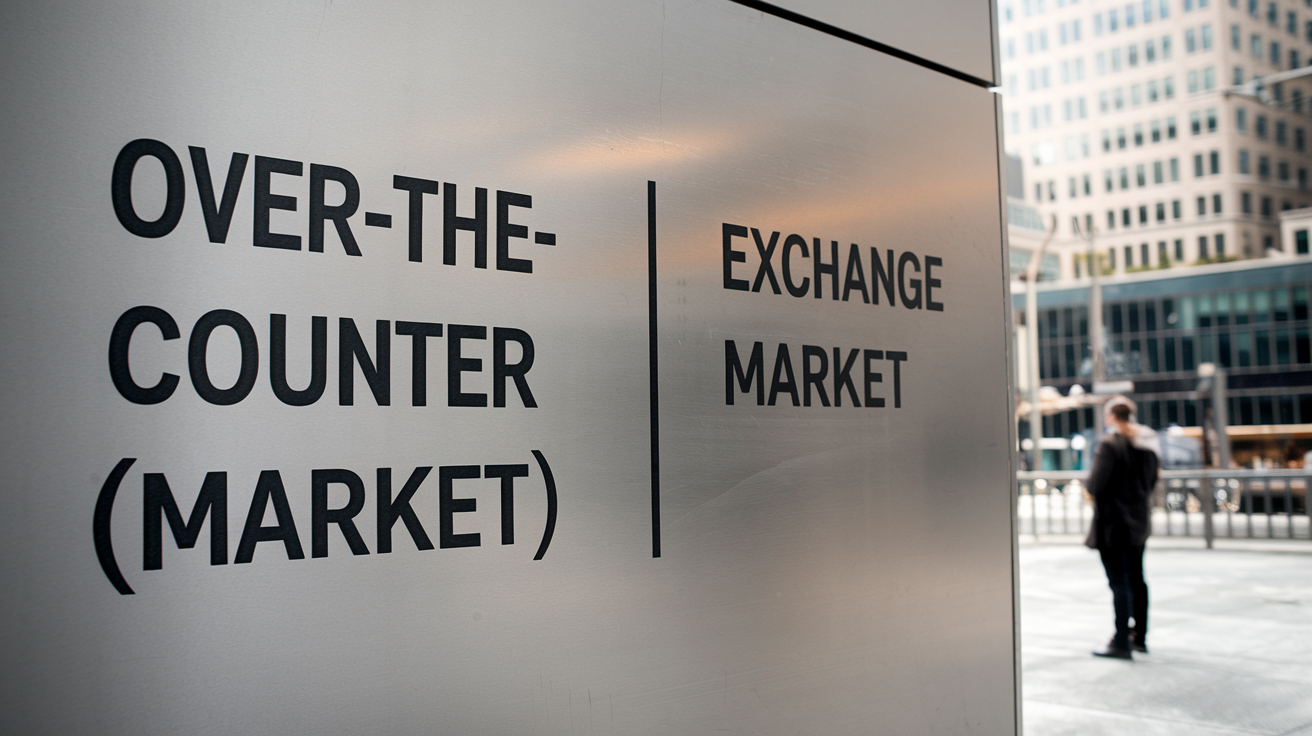
Access to that venue is what a retail trader gets from a broker, the middleman between you and the exchange. And here you have to separate two kinds of market. An exchange market is centralised: one shared order book, one official price, real volume that everyone can see. An off-exchange market, or OTC, is a set of deals struck directly between participants, with no single venue. The biggest off-exchange market on earth is Forex, and there the price and the spread you see are effectively shown to you by your own broker, with no market-wide volume figure anywhere. For a beginner, hold this in mind: on an exchange you see the whole market; on OTC you see a slice of it through a middleman.
What trades there is far from only currency. Shares, bonds, futures, commodities and precious metals all pass through the same venue, and the same broker opens the door to all of it. One detail that matters for trust: a sound broker and the exchange itself hold a regulator's licence, which is exactly why I always talk about a regulated venue rather than just any. To start, a person opens an account with a broker, and I'd run everything on a demo first, where the mechanics are identical and the money isn't real.
Say you hit buy at your broker: the order travels to the exchange, fills against the best opposing price at 1.08509, and comes back to you a fraction of a second later as an open position. The broker is only the pipe; the trade itself happens on the exchange.
In short: The exchange is the venue, the broker is your access to it, and on an exchange you see the whole market, while OTC shows only a slice through a middleman.
Who actually trades on an exchange: big capital and the crowd
An exchange doesn't match faceless orders; it matches very specific players, and a beginner gains more from knowing who they are than it looks. Roughly, everyone splits into two forces. On one side sits big capital: banks, funds and other institutional investors — professional players with deep pockets, research desks and cold discipline. On the other side is the retail crowd, private traders like you and me: there are many of us, but each one barely nudges the price alone.
Between those two forces stand the people who make trading possible at all. The broker gives you access and fills your orders without betting on direction. The market maker, by contract with the exchange, keeps both a buy and a sell quote standing in the book so the market always has someone to deal with, and earns the gap between them. The clearing house, more on which below, makes sure both sides honour the deal. This map isn't abstract theory for me: my whole approach is built on reading volume to see where big capital is actually working, and on not ending up against it shoulder to shoulder with a panicking crowd. Knowing who sits on the other side of your trade is what separates deliberate trading from playing blind.
In short: Two forces meet on an exchange, big capital (banks and funds) and the retail crowd, while the broker, market maker and clearing house supply access and liquidity; the point of the work is to read volume and stand with big capital, not the crowd.
What is a share, and why does its price move?
A share is a security that locks in a stake in a company for its owner, along with a claim on part of its profit and assets.
It is the basic brick of the market, the thing you meet first. Put simply, a company splits itself into many equal pieces and sells them to raise money to grow, and whoever buys a piece becomes a part-owner of the business. In return they get a claim on part of the profit as dividends and usually a vote at the shareholders' meeting. People make money on shares two ways: on the price rising, when the stock is bought cheaper and sold dearer, and on dividends, payouts from profit. By type, shares split into common, which carry a vote, and preferred, which usually get priority on dividends but no vote. The one thing a beginner must hold onto: a share is not an account, its price can fall, and in a bankruptcy the shareholder stands last in the payout queue. Dividends and the dividend gap are a big topic of their own, but the principle is simple: a dividend is the slice of profit a company chooses to hand out, and not every company pays, nor always.
For me as a trader, a share is first of all a chart driven by supply and demand, not a stake in a business. In my experience a beginner often buys a stock because the company is good or in the news, then is surprised when the price drops. Over a short horizon the quote is moved not by the quality of the business but by the balance of buyers and sellers on the exchange. I watch where real interest is building, not whether I happen to like the company. A long-term investor runs the opposite logic, and owning a good business for years is perfectly sound. It's simply a different horizon.
Two more things are worth keeping in mind. First, dilution: when a company issues new shares, every existing owner's stake shrinks. Second, liquidity: a large company's stock is easy to sell at any moment, while an illiquid share can be hard to offload at the price you want, and a beginner usually learns this at the worst possible moment. Neither is theory; both hit your money directly the moment you want out of a position.
In short: A share is a stake in a company and the market's basic instrument, but in the moment the price is moved by supply and demand in the book, not by the label "good company."
What can you trade on an exchange, and what trades off it?
A share is only one instrument; far more passes through an exchange. The same venue carries bonds, the debt IOUs of governments and companies, futures and other derivative contracts, commodities and metals such as oil and gold, and currency too. For a beginner the conclusion is simple: the plumbing of the market is the same everywhere; only what you're looking at changes. A bond is closer to a loan at interest and behaves more calmly than a share, while a futures contract is already an obligation to buy or sell an asset in the future, and the risk there is higher because of built-in leverage. So it makes sense to learn trading on one instrument you understand rather than spreading yourself thin across everything at once.
It also matters that not all trading runs through an exchange at all. The over-the-counter (OTC) market is a set of deals struck directly between participants, with no single centralised venue and no shared order book. The best-known example is the Forex currency market: there's no single exchange, the price and spread are essentially given to you by your counterparty, and there's nowhere to take one honest market-wide volume. That distinction is fundamental for me, because my analysis leans on real exchange volume, which is exactly why I prefer venues where it's genuine rather than estimated.
In short: An exchange carries not just shares but bonds, futures, commodities and currency, and since the plumbing is the same everywhere it pays to start with one instrument; meanwhile part of the market is off-exchange, like Forex, where no single honest volume exists.
How is a price set on an exchange? Supply, demand, and the spread
An exchange price is the price of the last trade, where a buyer and a seller met. Nobody hands it down from above; it's born from the balance of supply and demand at each moment in time.
The logic here is as clean as it gets. If buyers are keener and willing to pay more, demand outweighs supply and the price creeps up. If sellers are keener, supply wins and the price slides. In the book this shows up as the best bid and the best ask, and the gap between them is the spread, that is your hidden cost on entry. Here's the point I always stress: a market falls not because there are many sellers, but often because there are no buyers: demand has simply dried up. Grasping that matters more than any pattern on the chart, because you stop hunting for a sellers' conspiracy where demand merely walked away.
In short: An exchange price is the price of the last trade, born from the balance of supply and demand, and a market falls not from sellers as often as from demand that has dried up.
What is an order book, and which orders move the price?
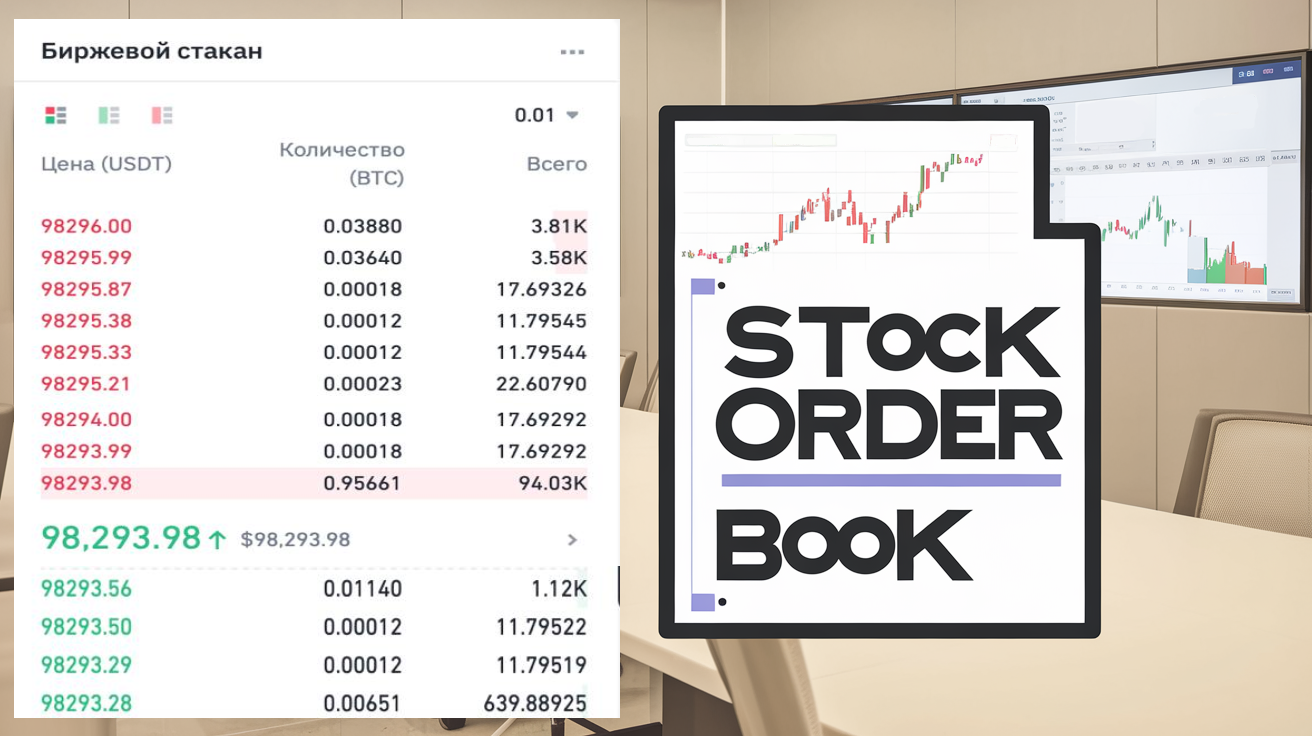
Now the actual place where all of this happens, the order book. It's a table of every live order: on one side the prices people are ready to buy at, on the other the prices they're ready to sell at. In effect it's a real-time map of supply and demand. And here lies the whole difference between the two order types. A limit order joins the book at its own price and waits for a counterparty; on its own it doesn't press on the price. A market order fills immediately at the best available price and, by doing so, moves the price as it picks orders out of the book. So it's market orders that push the price, eating through liquidity, and the imbalance in the book shows who's stronger.
The deeper mechanics of the book I move into a separate piece: how to read the spread and liquidity, why the market needs a market maker, and how a large market order eats through the levels of the book, all broken down in the article on market microstructure. Here it's enough to remember a simple rule: a limit order waits in the book, a market order moves the price.
In short: The book is a real-time map of supply and demand: a limit order stands and waits, while a market order fills at once and moves the price, eating through liquidity.
What is a clearing house, and why does honest volume depend on it?
A clearing house is the intermediary that steps between buyer and seller and guarantees both sides will meet their obligations on the trade. In effect it takes on the risk that the other side won't pay.
Here's why this isn't a formality for me, and it isn't advice aimed at you personally. On a regulated exchange like CME there's clearing, which means trades are matched transparently and you get an honest flow of volume that nobody can paint. And volume, for me, is the foundation of analysis: I look for where big capital genuinely entered and exited. That's the whole crux of it: on honest volume you can see where smart money stepped in and where retail is milling about, and those tracks can't be faked on a venue with clearing. Off-exchange there's no single honest volume like that, so I read real volume on CME futures rather than the rough version from decentralised venues. How I read CME exchange volume on a live chart I show in the video on Wyckoff volume analysis. And why volume is the cause of a move rather than its consequence is broken down in the course section on volume analysis.
In short: Clearing removes the risk of non-payment, so volume on a regulated exchange is honest, and it's that volume that shows the footprints of smart money, not the rough picture from decentralised venues.
When is the best time to trade? Sessions and liquidity
The market doesn't breathe evenly across the day, and that gets split into three main sessions: Asian, European and American. The Asian session is usually the quietest, with the market more often stuck in a range. The European session picks up pace as London opens and brings the bulk of the volume. The American session adds volatility, especially when US data drops. The most active and liquid stretch is the overlap of the European and American sessions, when the market holds the most participants.
The practical takeaway, from my own experience, is simple: better to trade less but at the right time, when there's volume and moves are readable. And when important news comes out and price lurches around chaotically, a beginner has no business stepping in, and that's one of those moments where people lose an account out of nowhere. From here the sensible next step is structured learning: I've put the whole base together, step by step, in the free trading course.
In short: The most liquid moment is the London–US overlap, and I'd rather trade less inside that window than all day on a thin market.
Frequently asked questions
The exchange is the trading venue itself, where deals are matched and the price forms. The broker is the intermediary a retail trader uses to reach it. So you trade on the exchange, but through a broker.
Price is set by the balance of supply and demand. When buyers are keener the price rises; when sellers press, it falls. The current price is the price of the last trade, where a buyer and a seller met, not a number set by anyone.
It is a table of all live buy and sell orders, a real-time map of supply and demand. Limit orders sit in the book and wait, while market orders fill at once and move the price, eating through liquidity.
It steps between buyer and seller and guarantees the trade settles, removing the risk that the other side won't pay. Thanks to clearing on a regulated exchange like CME, volume is honest and deals are matched transparently.
It is a security that gives its owner a stake in a company. By buying a share you become a part-owner of the business and gain a claim on part of its profit and, as a rule, a vote at the shareholders' meeting.
The most liquid stretch is the overlap of the European and American sessions, around the middle of the European day, when the market holds the most participants. Stepping in during major news releases is risky for a beginner because of chaotic moves.
About the Author
Author: Igor Arapov — independent researcher in the psychology of investment decisions and behavioral finance, practising trader since 2013, founder of arapov.trade, author of a trading book series (ORCID: 0009-0003-0430-778X).