Most beginners blow up on forex not because a forecast was wrong, but because they ignore the two things this market never forgives: risk on the trade and the pull of oversized leverage. The currency market has no central exchange and therefore no honest, centralized volume, so the sober way to read it is by price levels and the dollar's strength, not by staring at one pair. Get those foundations right and forex stops being a casino spin and starts being a craft.
The currency market is where many people take their first step into trading, and it was my own starting point too. I still watch these pairs closely, but soberly: across the table sit banks and market makers with vastly more money and information than any of us. Years at the screen taught me one blunt lesson, that the beginner is sunk not by a bad call but by the absence of risk control and the lure of big leverage. So I've gathered in one place everything worth grasping from day one, from how the market is built to how the dollar index ties it together.
In this article, we'll cover:
- how the forex market is built, who trades on it, and how it differs from stocks;
- what long and short mean, how to open and close a position, and where the swap comes from;
- why leverage burns accounts and how to keep currency risk under control;
- what the carry trade, the trading sessions and the dollar index are, and how I use them in practice.
Let's start with the foundation: what forex actually is and how this market is wired.
What is forex and how the currency market actually works
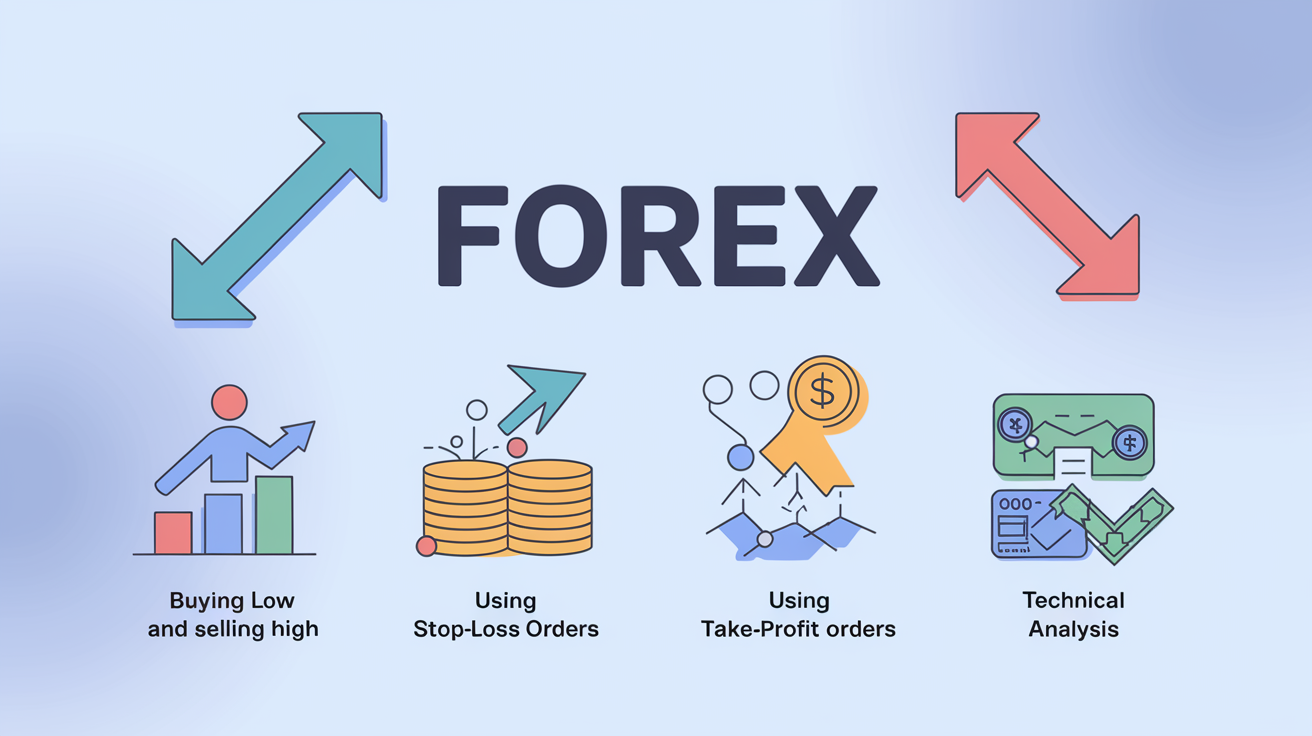
Forex is the international market where one currency is bought for another, and the name comes from Foreign Exchange. You don't trade currencies one by one here but in pairs, say the euro against the dollar, and the pair's price tells you how much one currency is worth in the other.
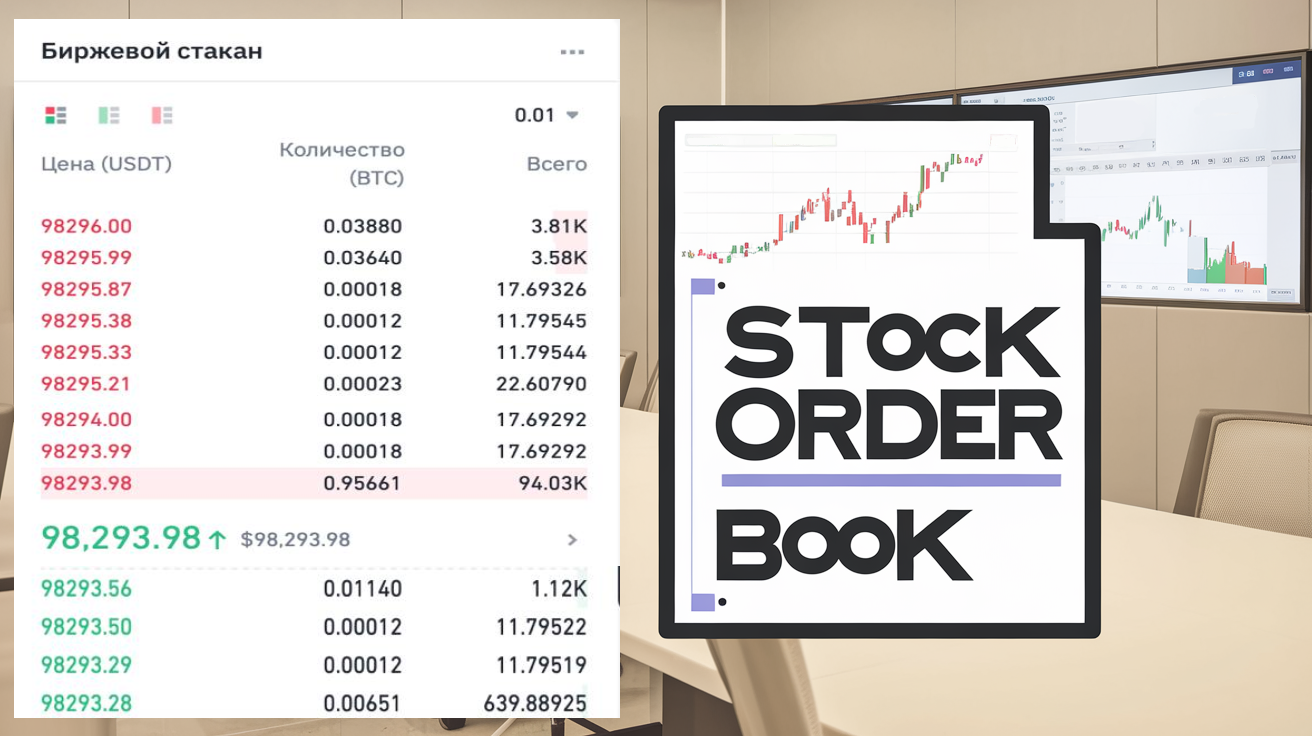
Everything about its structure rests on one word: decentralization. There is no single exchange the way there is for stocks; deals are struck directly between banks across the world, which is why people call it the interbank market. From that follows a conclusion central to my method: centralized volume for a currency simply does not exist here, it is only approximate. So I read pairs first by levels and by the dollar index, and when I want real volume I go to how the order book and market microstructure work, where it is exchange-traded and honest. The logic of volume analysis I lay out step by step in the course.
A pip is the smallest step in a forex quote, usually the fourth decimal place, or the second for pairs with the yen. Movement and risk are both counted in pips: on a standard lot one pip on EUR/USD is worth about ten dollars, so the lot size and the stop distance in pips set the money you risk directly. Currency pairs themselves fall into three groups. Majors, the main pairs such as EUR/USD and GBP/USD, always hold the dollar, carry the deepest liquidity and the tightest spread. Crosses run without the dollar, for example EUR/GBP, and cost a little more in the spread. Exotic pairs such as USD/TRY deliver huge moves, but the spread and the slippage there are painful. I myself count levels and volume rather than pips to a target, yet a beginner needs to grasp it: on forex all the risk arithmetic lives in pips and in the lot size.
In short: Forex is the global market for exchanging currencies, traded in pairs like EUR/USD; it is the largest and most liquid, yet decentralized, so there is no honest volume on a currency, and I read it by levels and the dollar index.
Who is really on the other side of your trade: banks, market makers and retail
Players of wildly different size meet on the currency market, and knowing who stands across from your trade pays off from day one. At the top sit central and major banks: they move gigantic volumes, and a regulator's rate decision sets the direction of whole trends. Next come the market makers, contracted to feed the market liquidity and hold a two-sided quote, always ready to buy and to sell so price moves without jagged jumps.
At the bottom of that pyramid are we, the retail traders, who account for only a sliver of turnover. The takeaway for a beginner is blunt and honest: you step onto the same field as banks holding incomparably more money and data. I long ago stopped trying to out-forecast them and instead follow the large capital, reading its footprints in price. And one warning on temptation: leverage on forex is enormous, and big leverage is a straight road to a blown account, which we will return to in detail.
In short: The forces on forex are mismatched: central and major banks set trends with rates, market makers hold liquidity, and retail is a small share of turnover, so I follow the large capital rather than try to outrun it.
Forex vs the stock market: the difference that matters most
Beginners often ask how the currency market differs from stocks, and the differences are several and fundamental. The first is structure: forex is decentralized with no single exchange, while shares trade on specific venues like the NYSE, where there is centralized volume that I value enormously in analysis. The second is the schedule: currencies live around the clock five days a week, flowing between world sessions, while stocks are available only during their exchange's hours.
The third is the instrument and the leverage: on forex it is currency pairs and, as a rule, large leverage, while on the stock market you buy a stake in a company and leverage is far more modest. Here my view runs against the crowd, and I won't push it on you: the thing that defines forex for a trader is not its size or liquidity but precisely the lack of honest volume. My method is the same everywhere, levels, volume, trend, but since there is no exchange volume on a currency, I lean on levels and the dollar index, and where I need clean volume I move to futures. A beginner I'd steer toward one or two main pairs like EUR/USD rather than scattering across dozens of exotic quotes with no clear logic of movement.
In short: The currency market is decentralized, runs around the clock five days and is generous with leverage, while exchange-listed shares have centralized volume; and for a trader the decisive thing is not size but the missing honest volume.
Going long vs going short: buying and selling explained
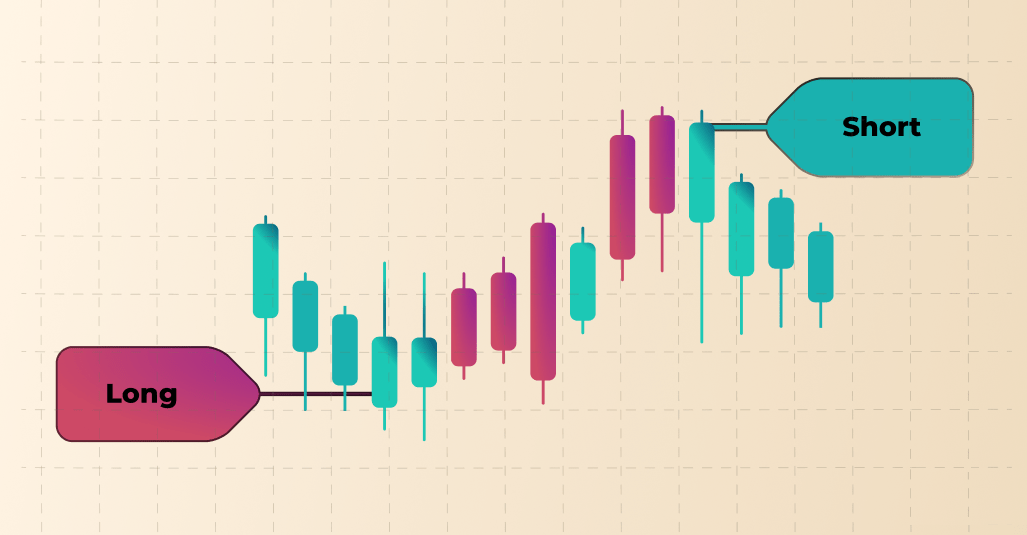
A long position is a purchase made expecting the price to rise: you buy cheaper to sell dearer later. A short position is the mirror bet on a fall: you sell a borrowed instrument higher and buy it back cheaper, keeping the difference.
Long is intuitive, an ordinary purchase. Short takes getting your head around at first: how do you sell what you don't own? On the currency market this is routine, the instrument is borrowed from the broker, sold, then bought back, which is why a trader can earn on a fall as well as a rise. Short also carries an important risk asymmetry: in a long you risk at most what you put in, while in a short a strong rally makes the loss, in theory, uncapped, and that is worth holding in mind at all times. Opening a position means entering the market, by buying for a long and selling for a short, and closing means the reverse operation. Profit or loss freezes exactly at the moment of closing; until then it floats and breathes with price. You can close in parts too: take half the size at the first target and trail the rest with the stop moved to break-even, which is also calmer psychologically. I always know in advance not only where I'll open but where I'll exit by stop and by target, and I set that before entry, not on emotion.
Technically the entry and exit are done with orders, and it helps to tell two types apart. A market order fills at once at the current price, when speed matters, while a pending order triggers only when a preset level is reached, when you want a specific mark and don't want to sit at the chart. And one rule the beginner usually learns through a first missed gain: while a position is open, any green on the screen is not yet yours, it becomes real only after closing. A good trade that reverses right before your eyes before you lock it in teaches that fast and expensively, so I plan the target in advance and hold to the plan rather than get greedy.
In short: Long is a bet on a rise, short a bet on a fall through selling a borrowed instrument; in a short the loss has no ceiling, and the result freezes only at closing, so I plan the entry, stop and target ahead of time.
What is a forex swap (rollover) and why holding overnight costs you
Don't close before the trading day ends and the position rolls to the next, and with that rollover a swap appears. It is a charge for carrying a position overnight, figured from the difference in the two currencies' interest rates. That is why a swap comes in two signs: negative when you pay, positive when you are paid. The rollover itself usually happens around 5 p.m. New York time, and the value date shifts then too, the date of actual settlement on the trade.
There is a detail that surprises almost every beginner: on Wednesday the swap is triple. Brokers book the upcoming weekend in advance, since trades settle two business days out. A day trader is indifferent to all of this, closing inside the day and paying no swaps at all. But held over days and weeks they pile up and quietly eat the result, so they cannot be ignored. This is not an instruction to you, just my own accounting on the trade: a swap is as much a line of cost as the spread. Sometimes it works in your favour, if you buy a high-rate currency against a low-rate one, and whole strategies are built on that effect, more below. Swap size differs noticeably between brokers, so for long holds it is worth comparing as carefully as commissions.
In short: A swap is the overnight charge from the rate difference, triple on Wednesday for the weekend; a day trader pays none, but over weeks it visibly eats the result, so I treat it as part of the cost of a trade.
Why leverage blows up beginner accounts
Leverage is borrowed capital from the broker that lets you control a position many times larger than your account by posting only a small collateral, the margin. At 1:100 you put up just one percent of the trade's size: a thousand dollars in the account moves a hundred-thousand position.
The whole danger hides in simple arithmetic. Leverage does not change the percentage the market travels, it only multiplies the effect of that move on your collateral. At 1:100 a move of just one percent against you wipes all hundred percent of your margin, and at a more modest 1:30 about three percent is enough. The higher the leverage, the less the market needs to knock you out of the game, and on news the price covers that percentage in seconds. The available leverage is set by the regulator: under EU and UK supervision retail gets about 1:30 on majors, in the US up to 1:50. Offshore brokers lure with 1:100, 1:500 and higher. I come at it from the other end and start not from the leverage but from the risk: I lose no more than one to two percent of the account on a trade, and only then size the position to that risk. This is not advice to you, just how I work, and I break down the mechanics in detail in the leverage section of the course. When a trade goes against you, a margin call lands first, a warning that almost no free funds remain, and if price runs further a stop-out follows, where the broker force-closes positions itself. In a normal market that saves the account from going negative, but on a sharp gap, as with the franc in 2015, the price jumps over the closing level and the balance goes into the red. Regulated brokers have negative-balance protection against this, offshore ones may not. So my rule is iron: I set the stop first, and only then think about size and leverage, never the other way round.
To make the numbers tangible, let me put them in margin terms. At 1:30 on a thousand-dollar account, a standard EUR/USD lot already needs around three thousand of collateral, meaning you simply cannot open a full position on such an account. And that is not the regulator being fussy, it is protection against instant wipe-out. Volatility works as a hidden multiplier: on a big data release the price covers its percentage in seconds, and an account on maximum leverage is carried out before you can react. It is no accident that, by the European regulator's data, the majority of retail accounts on such instruments sit in loss, largely down to excess leverage and weak risk control.
In short: Leverage multiplies profit and loss alike: at 1:100 a one-percent move can carry the account out, a margin call is the warning, a stop-out the forced close, and on a gap like the 2015 franc the balance goes negative, so I dance from risk and set the stop first.
Currency risk and how to actually manage it
Currency risk is the chance of a loss from an adverse shift in the exchange rate: you took a pair expecting a rise and it crawled down, and the risk has played out. On forex it is the trader's permanent companion, since rates swing without pause under news, inflation and central-bank policy.
But a drifting rate on its own is not so frightening; what makes it truly dangerous is leverage, inflating the position tens of times and able to zero an account in minutes. The professional defence against such risks, hedging through forwards, futures, options or an offsetting position, is first of all the gear of large business: a producer locks a future price through a futures contract to shield revenue. For a private trader with a couple of thousand in the account, building such constructions is both expensive and pointless. Their real defence is far simpler and rests on discipline: a stop-loss on every trade without exception, risk near one to two percent of the account, modest leverage, and focus not on one trade but on the distance. The market rewards not boldness but a system with positive expectancy. I have held to these rules for years and offer them not as a command to you but as the very support that survival on the market stands on.
In short: Currency risk is the loss from a rate move against the position, and leverage inflates it many times; hedging with derivatives is for business, while a private trader's defence is a stop on every trade, one-to-two-percent risk, modest leverage and focus on the distance.
The carry trade: earning the rate differential and its trap
A carry trade is a strategy where a trader borrows in a low interest-rate currency and invests in a high-rate one, pocketing the rate difference as income. The name is the English carry trade, trading on the hold, because the earning here comes precisely from holding the position, and on forex the difference drips in through that same swap.
All the profit here splits into two parts, and confusing them is dangerous. The first is the slow income from the rate gap, accruing crumb by crumb for each day held. The second is the move of the pair's own rate, and it can both multiply the earning and wipe it to zero. That is exactly why the carry almost always runs with leverage: without it the rate gap gives too little, and with it the risk grows by the same factor. Gauge the scale: a rate gap might bring a few percent a year, while a pair easily travels that much in a day or two on any meaningful news. What would take months to accumulate, the rate erases in a couple of days, and on a mass unwinding of such positions the high-yield currency collapses in an avalanche, so everyone sitting in carry on leverage catches a loss at once. The sober takeaway: this is not passive rent but a bet on rate stability that the market regularly breaks, so I don't recommend it to a beginner, and I hold it myself under a stop and small leverage.
To make it vivid, here is the classic construction. Historically the cheap funding currency was one with a rate near zero, while the yield leg was the currency of a high-rate country, and the pair between them became the symbol of the strategy. While such a pair stands still or creeps your way, you quietly gather the rate gap day after day and feel like a collector of rent. But the trap hides in that very illusion of calm: one shift in central-bank mood or a flash of panic is enough, and the currency you sit in with leverage turns sharply and against everyone at once. Income built over months vanishes in a day on such a turn, and leverage turns a moderate loss into a painful one.
In short: A carry trade earns the rate difference through the swap, but it is not passive income, it is a leveraged bet on the rate staying stable: one sharp move erases months of accrual, so the main risk here is not the rate but the price.
Best time to trade forex: sessions and the London and New York overlap
A forex trading session is the period when a given region's financial centre is active and the main flow of currency operations passes through it. That is exactly why the market spins around the clock on weekdays: the centres relay each other across time zones.
There are four sessions, handing off in a circle: the day opens with the quiet Pacific centred on Sydney, then the Asian with Tokyo and Singapore, then the busiest European with London, and last the American with New York. The main rule is simple: the more centres open at once, the higher the volume and the stronger the move. The hottest window of the day is the London and New York overlap, when Europe is still trading and America has already opened, and it is here that the most powerful moves are born on the major dollar, euro and pound pairs. EUR/USD in the Asian session is almost pointless to chase, with lower liquidity, narrower ranges and sluggish moves. My main thought on sessions I'd put like this: the clock doesn't trade, volume trades. The thin night market, pre-holiday days and the last hours of Friday I prefer to sit out, and on news I don't trade at all, because the spike there is deceptive and easily knocks out a stop even on the right direction. Better to skip an empty market than to feed the spread in hours when there is essentially nothing to move. The exact timing of when to step in by session I break down with examples in the video on choosing the best hours to trade by forex session.
It also helps to hold the pairs-to-sessions link in mind. The major dollar, euro and pound pairs come alive precisely in the European and American window, while pairs with the yen and the Australian dollar are more active in the Asian session. If you trade EUR/USD, hunting for movement in it at night is near useless: its main volume comes from London and New York. And one more caveat that matters specifically for forex: there is no single exchange volume here. So I lean not only on the session's clock but on levels and the dollar index, to gauge the real strength of a move rather than trust an empty night spike.
In short: There are four sessions by financial centre, and volume trades, not time: the working window is the London and New York overlap, the major pairs live in it, while the thin Asian session, the night and holidays are mostly noise best sat out.
The US Dollar Index (DXY): reading forex through the dollar
The Dollar Index is a gauge of the US dollar's strength against a basket of six major currencies, by which you judge whether it is firming or weakening. The basket holds the euro, yen, pound, Canadian dollar, Swedish krona and Swiss franc, and the euro weighs by far the most, which is why DXY largely mirrors the EUR/USD pair. The index was launched in 1973 with a base value of one hundred.
The index's chief use for me is that it gives direction. Since the dollar sits in most pairs, its strength or weakness often explains a pair's move better than the pair itself: the clearest example is the inverse correlation with EUR/USD, close to minus one. The index itself is driven above all by Fed rate policy, since a rate hike makes the dollar more yielding and firmer, and by demand for it as a haven, because in a crisis capital runs to the dollar as to a quiet harbour. Because of that DXY also works as a risk barometer: a confident dollar rally often means the market moving to defence and pressing on commodities and crypto. But the index is context, not an entry signal. I use it to pin the likely direction, and that alone cuts out half the illogical trades, like buying a currency against a clearly firming dollar. The actual entry I still hunt on the pair's own chart by my level and the price reaction, with volume confirmation. As that fundamental backdrop folds into the whole picture I show in more detail in the guide to fundamental analysis.
Separately I value the cross-check through the index. If a pair is rising but the dollar on DXY does not confirm it with a matching fall, I treat that move with suspicion and don't rush the entry: a divergence between pair and index often gives away a weak, unreliable trend. In my experience a beginner analyses the pair on its own, forgetting it has two sides, and a move is often explained not by the second currency but by the dollar. I do the reverse, looking first at what the dollar is doing, and that immediately cuts out half the illogical trades before I even open the pair's chart.
In short: DXY is context for direction, not a signal: most pairs hold the dollar, so I check its strength first, the inverse correlation with EUR/USD sits near minus one, and the entry I find on the pair's chart by level and reaction.
Forex is a convenient launchpad, but precisely because of the missing honest volume and the enormous leverage it is the easiest place to pick up expensive bruises. If you want to understand how exchange mechanisms work in general and where real volume comes from, the logical next step is the breakdown of how an exchange works, and from there to return to currencies with a different level of understanding.
Frequently asked questions
It is the global market for exchanging currencies, traded in pairs such as EUR/USD. The largest and most liquid market in the world, turning over more than seven trillion dollars a day, but decentralized: there is no single exchange, so no honest centralized volume exists for a currency.
It is legal in most countries when you use a properly regulated broker. Safe is another question: most retail accounts on these leveraged products lose money, mainly from oversized leverage and weak risk control. A stop on every trade and small risk per trade matter far more than the broker you pick.
You can open an account with very little, but account size is the wrong thing to fix on. What matters is risk per trade, kept near one to two percent of the account with the position sized to that. A tiny account on maximum leverage is far more dangerous than a modest one traded with discipline.
The question is not the size of the leverage but the risk on the trade. Keep risk near one to two percent of the account and size the position to that. Under EU and UK rules retail gets about 1:30 on majors, in the US up to 1:50, while offshore brokers lure with 1:100 and higher, which burns an account fastest.
In the overlap of the European and American sessions, when London is still working and New York has already opened. Participants and liquidity peak there, and so do the strongest moves. The thin Asian market, the night and pre-holiday days more often give noise than a clean move.
It is one number showing the dollar's strength against a basket of six currencies, the euro by far the heaviest. Since the dollar is in most pairs, the index points to the likely direction: you read dollar strength on DXY first, then look for the entry on the pair's own chart by level and price reaction.
About the Author
Author: Igor Arapov — independent researcher in the psychology of investment decisions and behavioral finance, practising trader since 2013, founder of arapov.trade, author of a trading book series (ORCID: 0009-0003-0430-778X).