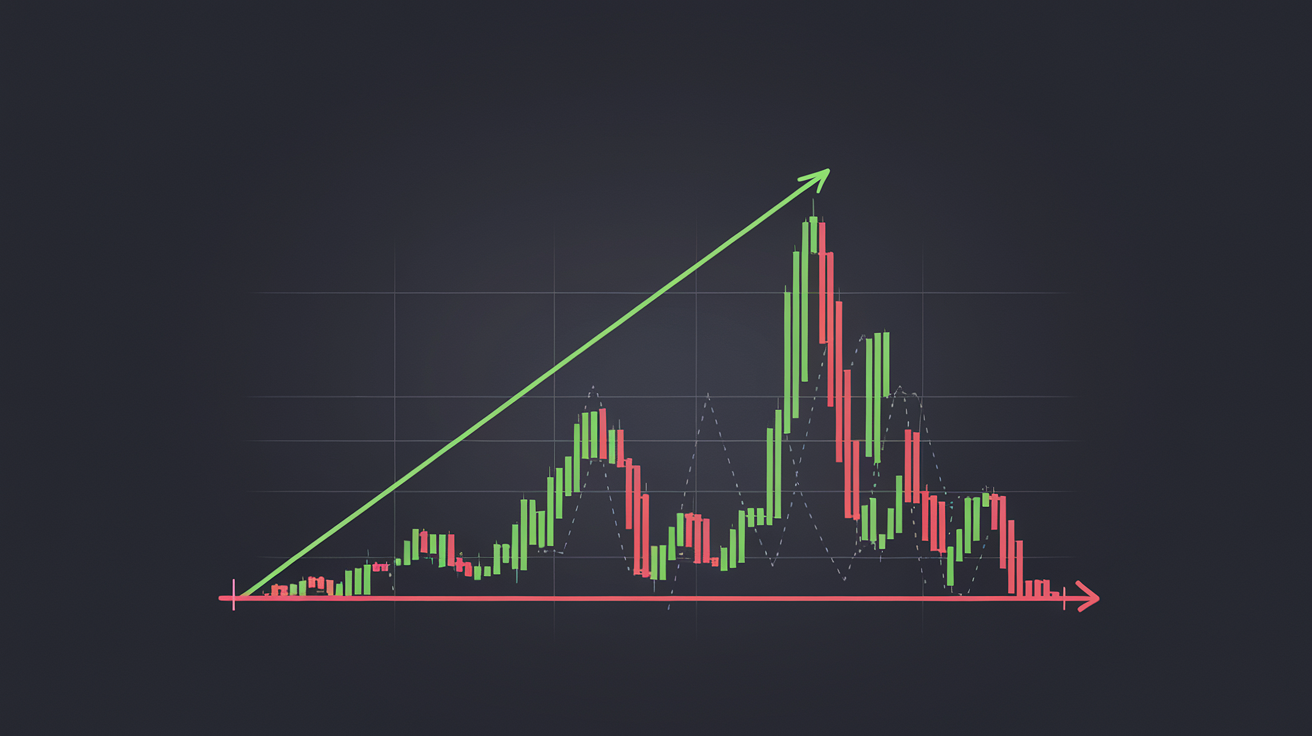
The hammer, doji and evening star are candlestick patterns that signal a possible price reversal. The hammer hints at a turn up after a fall, the doji shows the market's indecision, and the evening star warns of a turn down after a rise. But these signals work only at a strong level and with volume confirmation; on their own, in the middle of the chart, they more often deceive.
Candlestick reversal patterns are the first thing a beginner memorizes, and often the first thing they lose money on. I trade by volume and levels, and I treat these figures coolly: a single candle on its own means almost nothing. Let's go through what the hammer, doji and evening star are, how people try to trade them, and why without a level and volume they deceive.
In this article we'll cover:
- the hammer is a candle with a long lower shadow, a hint at a turn up after a fall;
- the doji is a candle where open and close nearly coincide, a sign of market indecision;
- the evening star is a three-candle reversal model at a top, a hint at a fall;
- these patterns work only at a strong level and with volume confirmation, not on their own.
Let's start by going through the patterns themselves, what each one means.
What the hammer, doji and star are: a breakdown of the patterns
Hammer — a candlestick reversal pattern with a small body at the top and a long lower shadow, which appears after a fall and hints at a possible turn of the price upward. The long lower shadow says sellers pushed the price down, but buyers brought it back.
The doji is built differently. It is a candle where the open and close prices nearly coincide, and the body turns into a thin line. The doji shows balance and indecision: neither buyers nor sellers took the upper hand, and the market froze in thought. On its own the doji says nothing about direction, it is only a signal of a pause. The evening star is already a three-candle model at the top of a rise: a strong rising candle, then a small indecision candle gapping up, and after it a strong falling candle. Together they paint a picture where the rise ran out and sellers seized the initiative, and the stronger the third, falling candle, the more convincing the signal. All these figures belong to candlestick patterns, which I cover separately.
In short.A hammer is a long lower shadow hinting at a turn up, a doji is market indecision, an evening star is three candles at the top hinting down.
How to trade these candles and where they work
Trading candlestick patterns head-on, right at their appearance, is the road to losses. On their own they fire too often and too randomly. They work in only one case: when they appear at a pre-marked strong level. A hammer at a support level the price has come to and bounced off more than once is a signal. A hammer in the middle of the chart, in empty space, is just noise you should not even react to.
The second mandatory condition is volume. A reversal candle at a level should be accompanied by raised volume, which shows that large capital came to this point. This is a direct illustration of the effort-and-result principle: if a reversal has both a level and big volume, the move gains a foundation. By logic it is the same story as with the pin bar, which also works only off a level. Where to mark strong support and resistance levels I cover separately, and the logic of priority-change levels in the course section on priority-change levels.
In short.I trade a candle only at a pre-marked strong level with raised volume; a hammer in the middle of the chart is noise I don't react to.
Why candlestick patterns deceive without a level and volume
The reason for the deception is in the very nature of a candlestick pattern: it is just one or a few candles, that is a very short and lagging signal. It shows what already happened over that stretch of time but guarantees nothing further. Many traders also wait for the next candle to close in the reversal direction before acting, treating the pattern as a warning rather than an instant trigger. On the chart dozens of hammers and dojis appear every day, and the overwhelming majority of them end in nothing, because they arise in random places with no support at all.
Add to this the large capital, which knows perfectly well that beginners trade these figures. A perfect hammer in an empty spot often turns out to be a trap: the price draws a pretty reversal signal, gathers a crowd of beginners into the trade, and then turns and goes against them. The choice of timeframe helps too. A candlestick pattern on a higher timeframe, for example the daily chart, weighs far more than the same pattern on minutes, because incomparably more volume and more participants stand behind it. A hammer on the daily at a major level is a serious signal; the same hammer on a minute chart is almost always noise. So I look at reversal candles first of all on higher timeframes. And that is why I never trade a candle on its own. First the level and context, then volume as confirmation, and only then the candle as the final trigger, not as a standalone signal. I'm not telling you what to do here, just describing my own order of work. A candlestick pattern is the last brick in a trade decision, not its foundation. How a reversal at a level looks on live examples with confirmation I show in my video on a reversal at a level with candlestick confirmation. The effort-and-result principle itself I cover in the course section on effort and result.
In short.First the level and context, then volume, and only then the candle as a trigger; a hammer on the daily at a level weighs far more than the same one on minutes.
Frequently Asked Questions
A hammer is a candle with a small body and a long lower shadow after a fall, a hint at a turn up. The long shadow shows sellers pushed the price down but buyers brought it back. It becomes a signal only at a level.
A doji is a candle where open and close nearly coincide and the body turns into a thin line. It shows balance and market indecision: neither buyers nor sellers took the upper hand. On its own it sets no direction.
It is a three-candle reversal model at the top of a rise: a strong rising candle, then a small indecision candle, and after it a strong falling one. Together they say the rise ran out and sellers seized the initiative.
Because it is a short, lagging signal of one or two candles. On their own, in the middle of the chart, they arise randomly and end in nothing. They work only at a strong level and with volume confirmation.
About the Author
Igor Arapov — independent researcher in the psychology of investment decisions and behavioral finance, a practising trader since 2013, founder of arapov.trade, author of a series of trading books (Open Library), (ORCID: 0009-0003-0430-778X).