How exchanges, orders, Forex, futures, options and bonds work, and how economic events relate to markets.
Short answers based on the ArapovTrade library. Each answer links to a detailed explanation. Trading approaches are presented as Igor Arapov's explanations; first-person wording refers to the author.
What Happens When You Place an Order
How does an exchange differ from a broker?
The exchange is the venue, the broker is your access to it, and on an exchange you see the whole market, while OTC shows only a slice through a middleman.
What roles do large investors, retail traders and market intermediaries play?
Two forces meet on an exchange, big capital (banks and funds) and the retail crowd, while the broker, market maker and clearing house supply access and liquidity; the point of the work is to read volume and stand with big capital, not the crowd.
What is a share, and how does the author explain its short-term price movement?
A share is a stake in a company and the market's basic instrument, but in the moment the price is moved by supply and demand in the book, not by the label "good company."
Which instruments does the source discuss as exchange-traded or OTC?
An exchange carries not just shares but bonds, futures, commodities and currency, and since the plumbing is the same everywhere it pays to start with one instrument; meanwhile part of the market is off-exchange, like Forex, where no single honest volume exists.
How does the author explain the price of the last exchange trade?
An exchange price is the price of the last trade, born from the balance of supply and demand, and a market falls not from sellers as often as from demand that has dried up.
How do limit and market orders interact in an order book?
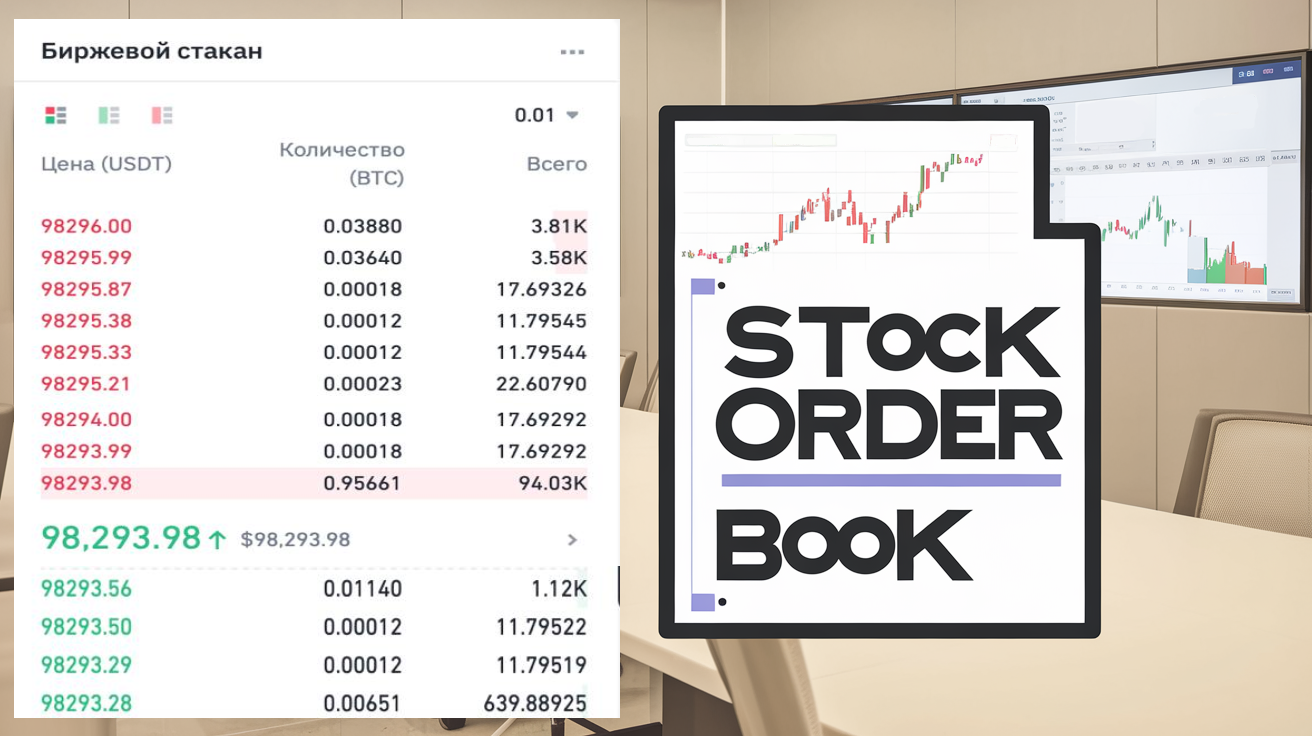
The book is a real-time map of supply and demand: a limit order stands and waits, while a market order fills at once and moves the price, eating through liquidity.
How does the source connect clearing with confidence in exchange data?
Clearing removes the risk of non-payment, so volume on a regulated exchange is honest, and it's that volume that shows the footprints of smart money, not the rough picture from decentralised venues.
Which session window does the author prefer for liquid trading?
The most liquid moment is the London–US overlap, and I'd rather trade less inside that window than all day on a thin market.
How does share issuance dilute an existing shareholder?
If a company issues additional shares and a shareholder does not increase their holdings, their percentage ownership declines. This is dilution: their share count may stay the same while the total number of shares increases.
How do common shares differ from preferred shares?
Common shares generally carry voting rights. Preferred shares may provide dividend priority and other rights defined by their terms. The share type alone does not guarantee dividends.
How Orders Actually Get Matched and Filled
How does the author explain price formation through supply, demand and volume?
Price is the agreement of supply and demand, not anyone's decision; you do not have to guess the cause, the result of the fight shows up in volume, where you see who holds the move.
What are Bid, Ask and the spread in an order book?
Bid is the best buy price, Ask the best sell price, and the spread sits between them; the book is a one-second snapshot, and an empty book is dangerous, since even an average order drags price when there is nothing to lean on.
Why does spread matter more for small profit targets?
The spread repeats on every trade: at three points it is a huge share of a scalper's five-to-ten-point target, and loose change for an entry aiming at hundreds; less often and more precise is almost always cheaper, and zero spread is not free.
How does the source connect liquidity, slippage and stop clusters?
Liquidity is absorbing an order without moving price; on a thin market it means a wide spread and slippage, while the zones where stops gather are pools that big capital drives price toward for a liquidity grab, which is why I hide my stop with room to spare.
How does the author use volatility and ATR for risk assessment?
Volatility is range, not direction, and it runs in cycles: compression gives way to an explosion, and by Wyckoff compression is often accumulation; I take ATR as a risk gauge for a stop at one and a half to three ATR and for position size, not as an entry signal.
How does the source distinguish a market maker's role from a trader's losses?
The market maker is a limit participant who gives liquidity and earns on the spread rather than hunting you personally; a trader more often loses because he set the stop in an obvious spot and went against capital, which is why I read volume, not the book.
What is wash trading, and how does it distort reported volume?
Participants manufacture apparent activity, including through self-trading. This volume does not represent independent demand in the same way as transactions between unrelated participants. The author considers this limitation when interpreting crypto-exchange data.
Market, Limit and Stop Orders: What's the Difference
What are the main types of trading orders?
An order is a command to the broker on set conditions, and it all rests on three pillars: the market order is speed without price control, the limit order is price control without a fill guarantee, the stop is a sleeping order until its level.
How does a market order trade execution speed for price uncertainty?
A market order fills instantly, but a large size walks the book and moves price itself, and the fee for speed is the spread plus slippage, which bites hardest on a thin market and on news.
How does the source describe limit orders and their execution trade-off?
A limit order is price control at the cost of an unguaranteed fill; big money enters with limits so as not to push price against itself, and lifts the very liquidity the crowd pours in with its market orders.
How do Buy Stop and Sell Stop orders activate?
A stop order sleeps until its level and on the touch becomes a market order; a Buy Stop is set above price, a Sell Stop below, and a cluster of stops, when triggered, spills into the market in an avalanche, so stop zones are fuel for a move.
How does a stop-limit order differ from a stop-market order?
A stop-limit is an order of two prices that controls the price but may not fill, while a stop-market fills always at the available price: one guarantees the price, the other the exit, so for protecting the account I take the stop-market.
How does the author place a protective stop-loss?
A stop-loss closes the position itself at a loss counted in advance, and with leverage the account zeros on a sharp move without it; you set it behind a structural level with a buffer and from it size the position at one-to-two-percent risk per trade.
How does the author interpret stop hunting around obvious levels?
The market knocks out stops where the crowd holds them, behind a round number and an obvious level: price is led there by a false break on weak volume and turned back, so I hide my stop behind the level with a buffer, not on it.
How does the author move a trailing stop as price advances?
A trailing stop pulls protection along after price and locks the gain already taken, jumping behind fresh extremes; moving a stop is allowed only into profit and on no account into loss in the hope of a turn.
What is an iceberg order, and what data can reveal its activity?
An iceberg is a big order cut into visible slices with the mass hidden; at a level it looks like absorption of the opposing flow, but without L2 and the tape a beginner finds it easier to catch its imprint in volume than the hidden order itself.
How does the author distinguish algorithmic execution from spoofing?
An algo order slices a big order so big capital gathers size without moving price; the order book can be faked with spoofing, volume cannot, so I look for the big player by a spike of volume without a price move at a strong level.
How do Day, GTC, IOC and FOK orders differ?
Day orders expire at the end of the session. GTC orders remain until execution or cancellation, subject to venue rules. IOC executes the immediately available quantity and cancels the remainder. FOK requires immediate full execution or cancellation.
How does an OCO order pair work?
OCO links two orders so that execution of one cancels the other. The library uses a stop-loss and take-profit pair as an example. Exact behaviour depends on the venue's implementation.
How to Start Trading Forex the Right Way
What is Forex, and why are currencies quoted in pairs?
Forex is the global market for exchanging currencies, traded in pairs like EUR/USD; it is the largest and most liquid, yet decentralized, so there is no honest volume on a currency, and I read it by levels and the dollar index.
What roles do banks, market makers and retail participants play in Forex?
The forces on forex are mismatched: central and major banks set trends with rates, market makers hold liquidity, and retail is a small share of turnover, so I follow the large capital rather than try to outrun it.
How does decentralized Forex differ from exchange-listed stock trading?
The currency market is decentralized, runs around the clock five days and is generous with leverage, while exchange-listed shares have centralized volume; and for a trader the decisive thing is not size but the missing honest volume.
How does the source describe long and short positions and exit planning?
Long is a bet on a rise, short a bet on a fall through selling a borrowed instrument; in a short the loss has no ceiling, and the result freezes only at closing, so I plan the entry, stop and target ahead of time.
How does the source explain Forex swaps and overnight holding costs?
A swap is the overnight charge from the rate difference, triple on Wednesday for the weekend; a day trader pays none, but over weeks it visibly eats the result, so I treat it as part of the cost of a trade.
How does the source distinguish leverage risk, margin call and stop-out?
Leverage multiplies profit and loss alike: at 1:100 a one-percent move can carry the account out, a margin call is the warning, a stop-out the forced close, and on a gap like the 2015 franc the balance goes negative, so I dance from risk and set the stop first.
How does the author approach currency risk for a private trader?
Currency risk is the loss from a rate move against the position, and leverage inflates it many times; hedging with derivatives is for business, while a private trader's defence is a stop on every trade, one-to-two-percent risk, modest leverage and focus on the distance.
How does a carry trade earn a rate differential, and what can erase it?
A carry trade earns the rate difference through the swap, but it is not passive income, it is a leveraged bet on the rate staying stable: one sharp move erases months of accrual, so the main risk here is not the rate but the price.
Which Forex trading-session overlap does the author favor?
There are four sessions by financial centre, and volume trades, not time: the working window is the London and New York overlap, the major pairs live in it, while the thin Asian session, the night and holidays are mostly noise best sat out.
How does the author use the US Dollar Index in currency analysis?
DXY is context for direction, not a signal: most pairs hold the dollar, so I check its strength first, the inverse correlation with EUR/USD sits near minus one, and the entry I find on the pair's chart by level and reaction.
Why is a pip different in yen currency pairs?
A pip is usually 0.0001 for most currency pairs and 0.01 for yen pairs, reflecting their quotation convention. Its monetary value also depends on position size and the currency used for account calculations.
How do major, cross and exotic currency pairs differ?
Major pairs include the US dollar; cross pairs do not. Exotic pairs include less widely traded currencies and may involve higher costs. Liquidity, spreads, and execution should be assessed for each specific pair.
Reading Economic Data Like a Trader
What does fundamental analysis contribute to the author's trading context?
Fundamentals value the fair price through the economy, rates and reporting; for an investor like Buffett it's a strength, but to a trader it says why the price moves, not when to enter.
Which economic factors does the source identify as market drivers?
Markets are moved by central-bank rates, inflation, employment, the trade balance, PMI, commodities and geopolitics; gold meanwhile stands apart as protection, and demand for it flares up on fear.
How does the author interpret GDP, PMI, inflation and employment relative to expectations?
GDP lags, PMI leads with a 50 boundary, inflation and employment rule the rate; but the market is moved by the gap with expectations, not the fact, so at the data release itself I don't enter.
How does the author describe central-bank rates and their market effects?
A rate up firms the dollar and pressures risk, down the other way, and a lag of more than six months stretches the trends; the Fed sets the tone for the world, and I don't guess the meeting but follow capital's reaction on the chart.
How does the source explain risk-on and risk-off regimes?
Macro hits the market through the rate: dear money firms the dollar and turns on risk-off, cheap money drives capital into stocks, commodities and crypto in a risk-on regime, and at the centre of the system stands the dollar.
How does the author use the economic calendar?
The calendar is a schedule of news with a forecast and importance; its job is to warn, not to give a signal, so the market is jolted most by the NFP of the first Friday, inflation, Fed rates and GDP.
Why does the author distinguish market expectations from published outcomes?
The market lives on expectations, not the fact: large capital, by Wyckoff, prepares half a year to a year ahead, so retail is late, and I enter by the footprint of volume at a level, not by the forecast.
Why does the author wait for a price reaction after major news?
Don't enter at the moment of the news, where the spread and the double spike knock out even the right direction; wait until the dust settles, and take the entry by volume and the price's reaction at a level, keeping fundamentals only as a background.
What does the COT report show, and why is it context rather than an immediate signal?
COT reports show how futures positions are distributed across participant categories. Because publication is delayed, the author uses them to assess positioning and market context rather than to time an immediate entry.
Stocks, Forex, Crypto, Commodities: What's the Difference
How does the author analyze XAU/USD and manage gold-trading risk?
XAU/USD is the price of an ounce of gold in dollars, a safe-haven asset with rates set by the Fed as its driver; I read it by the volume of CME futures and round levels, and the risk, because of the sharp moves, I keep around half a percent.
How does the source distinguish WTI and Brent and their price drivers?
Oil is available through CL futures on WTI (NYMEX) and Brent (ICE), and the gap between the grades is called the Brent-WTI spread; the price is driven by demand, OPEC+ quotas and geopolitics, but for me that is a backdrop, the entry I take by volume.
How does the source describe stock indices and instruments for trading them?
An index is a basket of stocks in one number; the Dow and Nikkei count by the price of the stock, the S&P 500 by capitalisation, while the Nasdaq is the most volatile of all; they are taken through ETFs (SPY, QQQ) and E-mini futures, whereas leveraged ETFs undermine the account over the long run.
How does the author apply levels, volume and risk control across assets?
Gold, oil and indices I read the same way, by levels, volume and a false break on exchange futures rather than on CFDs; news I keep as a backdrop, the risk because of the volatility around half a percent, and leverage I don't advise a beginner.
How does the EIA oil inventory report contribute to market context?
Inventory data adds information to the supply-and-demand assessment. Market reactions also depend on expectations. The author treats the release as context and then examines price and volume.
Which Market Should You Trade
What does trading a derivative mean in the author's explanation?
You trade a contract on the asset, not the asset, there are four kinds of derivative, and what I value is exchange-traded futures precisely because only they hand you honest volume.
How does the source describe a futures contract and its clearing?
A futures contract is a binding exchange contract run through a clearing house, and most futures are cash-settled, so no barrel of oil travels anywhere and the speculator closes out before expiry.
How does the author compare unleveraged spot ownership with futures exposure?
Spot is owning the asset with no leverage, where the most you lose is what you put in; futures is a leveraged position on price with a life span and liquidation risk: BTC from a hundred to eighty you wait out on spot, on leverage it carries you out.
Why does small futures margin not mean a small position risk?
Margin is small but profit and loss count on the full contract: on crypto, BTC at seventy-one thousand with a slide to fifty is already minus twenty-eight percent, which is why I hold risk in a trade at one to two percent.
Why does the author suggest learning spot before futures?
A beginner is safer on spot: no leverage, no liquidation, you can learn without zeroing the account overnight; move to futures later, once leverage, margin and liquidation are clear, by the rule buy and hold is spot, need a short is futures.
What is an over-the-counter swap?
A swap is an agreement to exchange payments under an agreed structure. The parties define its terms, generally outside an exchange. It belongs to the family of derivative instruments.
How does an option right differ from a futures obligation?
An option buyer pays a premium for a right they are not required to exercise. A futures contract imposes obligations under its terms. This creates different risk and settlement structures.
How does a forward differ from an exchange-traded future?
A forward uses individually negotiated terms. An exchange-traded future has standardized specifications and exchange-based settlement infrastructure. This affects liquidity, transparency, and how obligations are fulfilled.
What happens when a futures position is marked to market and margin becomes insufficient?
Price changes affect the position's margin balance. Insufficient margin can require additional collateral or a reduction in exposure, and forced closure may occur. Exchange and broker rules determine the conditions.
What Happens When You Buy a Bond
What is a bond, and how does it differ from a share?
A bond is formalized debt: you are the creditor, you are promised the return of the face value by the maturity date and a coupon paid; unlike a share, it is a debt with fixed terms, not a stake in a business.
How does the source explain bond prices, rates and buying below face value?
A bond's price is inversely linked to the rate: the rate rises, new issues give more, and old securities with a low coupon get cheaper; buy below the face value, and the yield is above the coupon.
How does the source distinguish coupon, current yield and yield to maturity?
The coupon is a fixed percent of face value and never moves; current yield measures that coupon against today's price; yield to maturity adds the price-to-face gap, and that's the figure to compare bonds by.
What risks does the author associate with government and corporate bonds?
Reliable does not mean risk-free: government securities keep rate risk, corporate ones also default risk; an ultra-high yield is payment for risk, not a gift.
How does the author use bond yields as a macroeconomic signal?
Bonds are an investor's instrument, not a retail trader's, but yields are a clean macro read: they track the central-bank rate, which drives the dollar and through it risk assets, so the curve works as a barometer of risk-on versus risk-off.
What does bond duration measure?
Duration helps assess how sensitive a bond's price is to changes in yield. Other things being equal, a higher duration implies a larger price response. The library discusses it in the context of interest-rate risk.
What is an inverted yield curve?
An inversion occurs when shorter-term bonds yield more than longer-term bonds. It is considered an indicator of expectations and macroeconomic stress. The author treats it as context rather than a precise schedule of future events.
What does a corporate bond yield spread indicate?
The difference between a corporate bond's yield and a comparable government bond's yield indicates an additional premium for risk and instrument characteristics. A wider spread does not automatically imply a better investment.
About the author
The library materials were prepared by Igor Arapov, a practising trader since 2013.